
Homeowners Insurance in Miami Springs, FL
Cornerstone Insurance is an independent Florida agency, and we compare 20+ Florida homeowners carriers for Miami Springs homes. The housing here spans a full century — from the Pueblo Revival originals of Glenn Curtiss’s 1926 Country Club Estates to the concrete-block ranches that housed airline families — and carriers price those building eras very differently, which is exactly why this market rewards shopping. And flood is its own policy — or endorsement — everywhere in Florida, Miami Springs included.
Independent Florida agency · FL license L061107 · Serving Miami Springs and all 67 Florida counties
What Shapes Homeowners Insurance Rates in Miami Springs
The claim we handle most often in Miami Springs isn’t a hurricane claim — it’s water damage from inside the house. Supply lines, water heaters, washing-machine hoses, and A/C condensate lines fail without warning, and in a city where much of the housing dates to the 1920s through the 1960s, the age and type of the plumbing behind the walls matters as much as the pipes’ condition. We encourage clients to carry as much water-damage coverage as they can qualify for — recent water losses, the home’s age, and original or partially updated plumbing can limit or even exclude water coverage with some carriers. It’s also a risk you can price down: several carriers give meaningful discounts for automatic water shut-off or leak-detection devices, and because carriers treat water damage so differently, the same Miami Springs home can quote very differently across the market.
On wind, the everyday exposure is the summer thunderstorm season — the sea-breeze storms that build over the Everglades and roll east across the county bring straight-line wind, hail, and some of the most frequent lightning in the country, and they generate far more claims year over year than named storms do. The named-storm exposure is still the one that sets the rules here: Miami-Dade sits in Florida’s High-Velocity Hurricane Zone, a two-county club shared only with Broward, where new Risk Category II construction is designed to 175-mph three-second gusts and impact-rated openings are required by the Florida Building Code. Hurricane Andrew’s Category 5 landfall near Homestead on August 24, 1992 is the reason that code exists. For your premium, the practical lever is documentation: a wind-mitigation inspection that records your roof attachment, roof shape, and opening protection can unlock some of the largest discounts available on a Florida policy.
Sinkholes are a question we get because they make Florida headlines, so here’s the honest local answer: Miami-Dade has minimal reported sinkhole activity, and Miami Springs is a long way — geologically and literally — from the karst belt north of Tampa where the problem concentrates. Every admitted Florida policy automatically includes catastrophic ground cover collapse, and the details worth knowing live in the FAQ below.
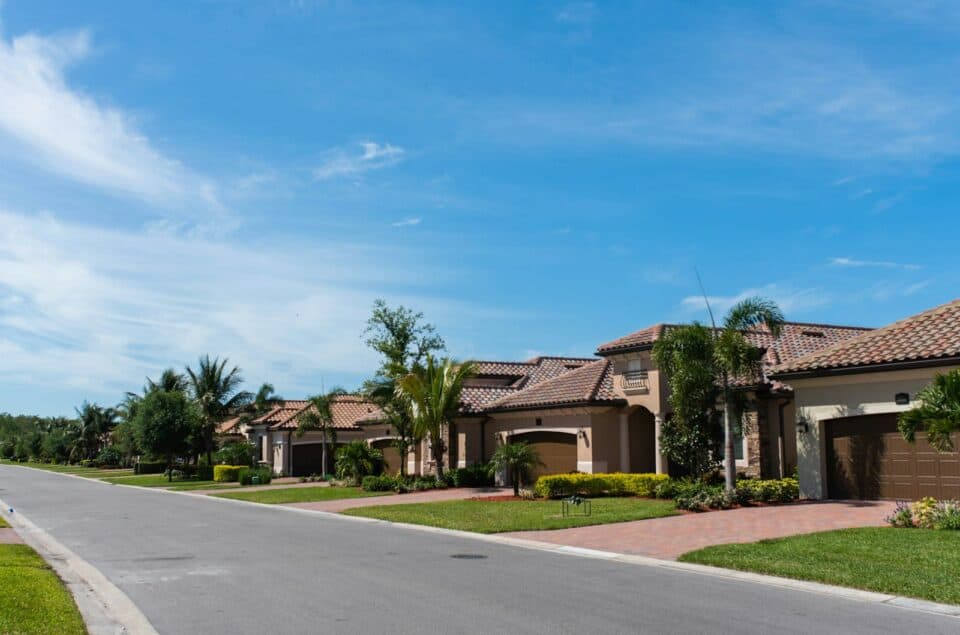
The housing stock is where Miami Springs gets interesting to an underwriter. The city was incorporated in 1926 as Country Club Estates, Glenn Curtiss’s planned development, and the Pueblo Revival originals — thick masonry walls, flat roofs, rounded parapets — still stand along Curtiss Parkway and the streets radiating off the Circle. Around them are the concrete-block ranches of the 1940s through 1960s, built as Pan Am and Eastern families settled a bedroom community beside the airport, and larger homes ringing the Miami Springs Golf & Country Club. Carriers don’t price age on a straight line; they price building eras as cohorts, by construction type and that cohort’s claims record, so a solid 1926 masonry original can genuinely outperform a fast-built later home. Documented roof age lives inside that same driver: on 1950s-built homes and older, carriers price the roof they can see paperwork for, so keep permits and inspection reports. For the county-wide picture — carriers, Citizens, and the HVHZ rules — see our Miami-Dade County home insurance guide.
Auto Insurance in Miami Springs, FL
Miami Springs drivers live surrounded by some of the heaviest traffic in Florida — NW 36th Street and the airport perimeter to the south, Okeechobee Road along the canal, and LeJeune Road feeding Miami International. Metrobus runs those perimeter corridors and a local Miami Springs/Virginia Gardens shuttle circulates, but inside the residential streets daily life runs on the household’s own cars. In traffic this dense, with this much rental and commercial activity around the airport, we recommend at least 100/300 in liability limits — the level leasing companies typically require — with higher limits where they fit, and uninsured/underinsured motorist coverage added, because a meaningful share of the drivers around you carry little or none. If you want a larger layer above all of it, that’s the umbrella conversation below.
One genuinely local wrinkle: the city allows low-speed vehicles and mini trucks on its residential streets — but not on NW 36th Street or NW 42nd Avenue, which are state roads. An LSV is a titled, registered motor vehicle that generally needs its own insurance, and how a golf cart or LSV is covered varies by policy and carrier — worth a five-minute conversation before it leaves the driveway. We compare auto alongside home, and the same-carrier bundle is often one of the larger discounts on both policies. Full details on our Miami Springs auto insurance page.
Flood Insurance in Miami Springs, FL
In Miami Springs the flood question is never whether — it’s how much. The Miami Canal runs the city’s entire northeastern border on its way to the Miami River, and the Ludlam, Melrose, and Esplanade Drive canals thread through the neighborhoods; the city itself notes that the majority of Miami Springs sits in or near a FEMA Special Flood Hazard Area. Underneath it all, the Biscayne Aquifer’s top sits roughly 2 to 5 feet below the land surface across much of the county — the ground is already nearly saturated, so a stalled summer downpour has very little room to soak in before it starts standing. Being inland of Biscayne Bay puts storm surge lower on the list here than for the coastal cities, but that’s a footnote, not the point: flooding is decided by your home’s immediate surroundings — its elevation relative to the houses and streets beside it, the nearest canal, and how fast the block drains — and it can and does happen far from any coast.
Standard homeowners policies exclude flood — a few carriers offer optional flood endorsements, never automatic — so flood protection is a separate decision on every policy we write. Under FEMA’s Risk Rating 2.0, premiums are driven by distance to a flooding source (those canals count), rebuild cost, and elevation and first-floor height — not by the letter on a flood-zone map — and most existing NFIP policies can’t increase more than 18% per year under federal law. NFIP coverage caps at $250,000 for the building and $100,000 for contents; for Miami Springs homes above those numbers, private flood markets can quote higher limits. One scheduling note if you’re with Citizens: Citizens ties flood insurance to wind coverage — a statewide requirement phased in through January 1, 2027.
Umbrella Insurance in Miami Springs, FL
An umbrella policy adds an extra layer of liability protection — typically $1 million or more — above the limits on your home and auto policies. In Miami Springs the exposures that make it worth pricing are ordinary ones: backyard pools, dogs, teenagers learning to drive, and daily miles through some of the most congested corridors in the state, where a serious at-fault accident can outrun auto limits quickly. If there’s an LSV or golf cart in the household, that’s one more thing rolling under your liability.
Umbrella carriers set their own minimum limits on the policies underneath, and most ask for more than the auto floor we recommend: commonly 250/500 bodily injury or a $300,000 or $500,000 combined single limit on the auto, $300,000 of personal liability on the home, and similar limits on any boat or motorcycle policy, so we quote the umbrella and the underlying policies together. We quote umbrellas alongside the home and auto so the underlying limits line up the first time.
One Miami Springs Quote Request. 20+ Florida Homeowners Carriers.
We’re an independent Florida agency, so we represent many carriers rather than one — one quote request and we compare 20+ Florida homeowners carriers and 25+ carriers across our personal lines. That matters in Miami-Dade more than almost anywhere: no Florida county has held more Citizens policies — at times roughly 24% of the personal-residential book statewide — and the county’s count fell from 168,103 at the end of 2024 to under 70,000 by May 31, 2026, as private carriers assumed more than 546,000 policies statewide in 2025. Movement on that scale is why re-shopping pays here: the carrier that priced a 1926 Pueblo Revival or a 1955 block ranch best a few years ago often isn’t the one that prices it best the next time it’s quoted.
The fastest way to accurate quotes: share your current policies securely through Canopy Connect — it takes about a minute, and we quote from your real coverage instead of guesses.