
Homeowners Insurance in Apalachicola, FL
Cornerstone Insurance is an independent Florida agency, and we compare 20+ Florida homeowners carriers for Apalachicola and Franklin County homes. Insuring here means placing one of Florida’s largest collections of 19th-century frame houses in a coastal market where carrier appetite runs thin — so which carriers will actually quote your home’s era, materials, and documented roof matters more than anything else on the application. And flood is its own policy — or endorsement — everywhere in Florida, Apalachicola included.
Free, no obligation — talk to a licensed Florida agent today.
What shapes homeowners insurance rates in Apalachicola
Ask what generates the most claims in Franklin County and the answer isn’t a hurricane — it’s water from inside the house. Supply lines, water-heater tanks, washing-machine hoses, and slow leaks under old flooring produce more losses than any storm season, and in a town where about 6.6% of homes predate 1940, a house may be on its second or third generation of plumbing. We encourage clients to carry as much water-damage coverage as they can qualify for, because some carriers limit — or exclude — water coverage based on recent water losses, the age of the home, or the type and age of its plumbing, and each of our 20+ carriers draws those lines differently. A monitored water shut-off or leak-detection device can earn a discount with several carriers and, more usefully, stop a pinhole leak from becoming a torn-out heart-pine floor. Fire sits at the other end of the frequency scale: far less common, but the most severe loss a frame house can take — which is why the rebuild limit deserves real attention here.
Most storm claims on this coast don’t come with names. Summer thunderstorms building over the bay throw straight-line wind, hail, and frequent lightning dozens of afternoons a year, and they account for the bulk of the storm losses we handle. Named storms are the second chapter, and Apalachicola’s is plainly documented: Hurricane Michael in 2018 pushed roughly 7 to 8 feet of storm surge into the Apalachicola and Carrabelle waterfronts, and Hurricane Helene in 2024 left about $23 million in damage to homes and structures across Franklin County. A wind-mitigation inspection is worth ordering on almost any home in town — even a 19th-century-built house can often document features that earn credits, and on a coastal premium those credits are meaningful money.
One risk you can largely set aside: Apalachicola stands on coastal sand and marsh, not the karst limestone that drives sinkhole activity in inland Florida, and reported sinkhole claims in Franklin County are minimal — the ground story here is entirely Gulf wind, surge, and water.
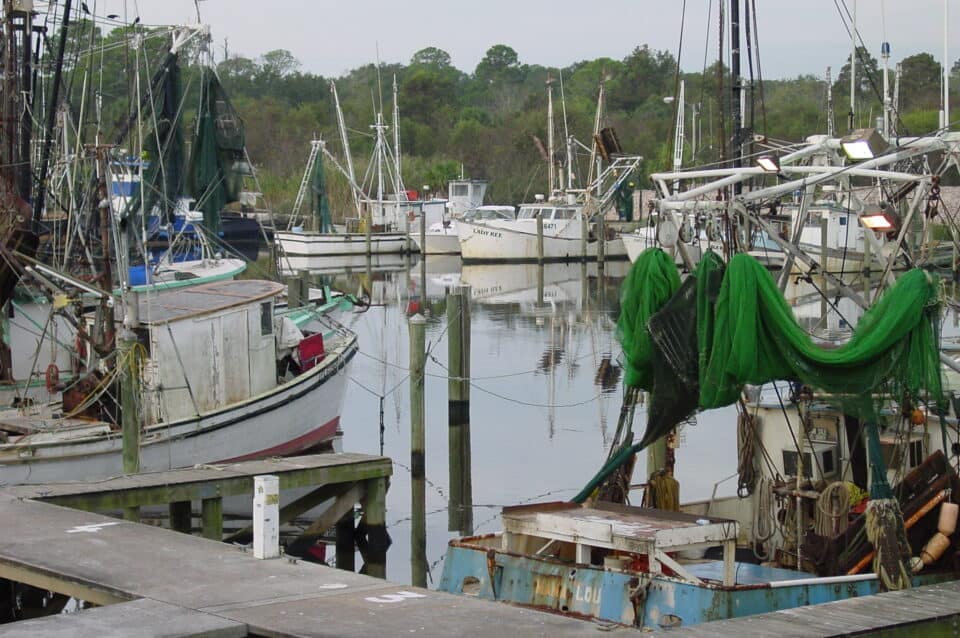
The housing story is the historic district. Apalachicola holds more than 900 historic homes and buildings dating from the 1830s — merchants’ Victorians and Classical Revival cottages near the waterfront, and the cypress-and-heart-pine shotgun houses of The Hill neighborhood — one of the state’s largest surviving 19th-century townscapes. Carriers price building eras as cohorts, by construction type and that cohort’s claims record, not on a straight age line: a maintained 1890s heart-pine house with a documented newer roof can be easier to place than a fast-built 1980s frame home, and documented roof age lives inside that same driver — carriers price what the paperwork proves. Your Coverage A matters just as much: carriers embed replacement-cost estimators to gauge the rebuild-cost limit on every quote rather than guessing, and on period construction those numbers run high — milled heart pine and historic millwork cost real money to reproduce, which is also why law & ordinance coverage earns its keep in a district with preservation standards. Two more local wrinkles shape underwriting: manufactured homes are about 17.4% of Franklin County’s housing stock, more than double the statewide share, and roughly 40% of the county’s housing units sit vacant much of the year — mostly seasonal — so occupancy (primary, secondary, or short-term rental) is a question we settle before quoting, not after. The manufactured-home wrinkle gets a full treatment in our Florida mobile home coverage guide. County-level carrier detail lives on our Franklin County home insurance guide.
Auto insurance in Apalachicola, FL
US-98 is effectively the only road: it crosses the John Gorrie Memorial Bridge from Eastpoint, runs through downtown as Avenue E, and continues west up the coast. Franklin County has no fixed-route bus service — the closest thing is Big Bend Transit’s transportation-disadvantaged program, eligibility-gated weekday rides — so every working adult here drives, and households run as many vehicles as they have drivers. Add a working waterfront and the driveway picture is pickups, boat trailers, and a teenager’s first car, all funneling onto one two-lane coastal highway that carries every trip in and out of town.
We recommend at least 100/300 in liability limits — the level leasing companies typically require — with higher limits where they fit your situation. We also add uninsured/underinsured motorist coverage on nearly every policy we build: a single corridor means you share it with every minimally insured driver passing through, and UM/UIM is designed to help close that gap when the other driver can’t. If you have real assets behind you, the umbrella section below is the natural next step. Bundling home and auto with the same agency frequently unlocks a discount on both sides — and our Apalachicola auto insurance page covers the local detail.
Flood insurance in Apalachicola, FL
In Apalachicola the flood conversation starts at how much, never whether. The city’s official elevation is about 16 feet, but that describes one benchmark, not your lot: flooding is decided by a home’s immediate surroundings — its elevation relative to the properties beside it, the soil beneath it, and where the water goes when several inches of rain fall fast. The state’s vulnerability analysis for the city maps this plainly: riverfront blocks between Avenue H and Scipio Creek are partly wetland already, and heavy rain alone can put water several feet deep on parts of Avenue H and Palmetto Street — no hurricane required. Storm surge belongs in the record too — Michael’s 7 to 8 feet is the modern benchmark — but it’s one note in a story that mostly reads rain, river, and tide.
Standard homeowners policies exclude flood — a few carriers offer optional flood endorsements, never automatically — so it takes a separate policy or endorsement to close the gap. The National Flood Insurance Program prices under Risk Rating 2.0, which rates each individual home on its distance to flooding sources, its rebuild cost, and its elevation and first-floor height — not the letter on a flood-zone map — and a 2014 federal law caps annual increases on most existing NFIP policies at 18%. NFIP coverage tops out at $250,000 for the building and $100,000 for contents; private flood carriers can go higher and sometimes price competitively on elevated or newer construction. One more mechanic worth knowing if you’re quoted there: Citizens ties flood insurance to wind coverage — a statewide requirement phased in through January 1, 2027.
Umbrella insurance in Apalachicola, FL
An umbrella policy is designed to add $1 million or more of liability protection over the limits already on your home and auto policies — a second layer that can help when a serious claim runs past the first. Apalachicola life supplies plenty of liability surface: boats and the docks they tie to, guests in seasonal and short-term rental homes, dogs, and young drivers sharing one two-lane highway with loaded boat trailers. For what typically works out to the cost of a modest dinner out each month, an umbrella is usually the cheapest large number in insurance.
Umbrella carriers set their own minimum limits on the policies underneath, and most ask for more than the auto floor we recommend: commonly 250/500 bodily injury or a $300,000 or $500,000 combined single limit on the auto, $300,000 of personal liability on the home, and similar limits on any boat or motorcycle policy, so we quote the umbrella and the underlying policies together. We quote umbrellas alongside home and auto so the layers line up, subject to each policy’s terms.
One Apalachicola quote request. 20+ Florida homeowners carriers.
Not every Florida carrier writes this close to the Gulf. Appetite in Franklin County runs thinner than inland, and part of the comparison is knowing — on the day you call — which of our 20+ Florida homeowners carriers are open in Apalachicola, which are paused, and which will look hardest at a 19th-century frame house with a documented roof. Citizens’ Franklin County policy count fell from 873 at the end of 2024 to 408 by April 30, 2026, as private carriers took policies back through depopulation. Wind-only placement has long been part of this coast’s market — on that same date, Citizens’ wind-only policies in the county (293) outnumbered its full multiperil ones (115) — and we work with wind specialists such as US Coastal alongside full-coverage carriers to assemble the pieces.
We’re an independent Florida agency — 25+ carriers across our personal lines — with a team serving all 67 counties. One quote request puts your home in front of the whole market at once, and we’ll tell you straight which placements are realistic. Already insured? Share your current policies in about a minute through Canopy Connect and we’ll re-shop them against the field.