
Homeowners Insurance in Bal Harbour, FL
Every property in Bal Harbour sits on a barrier island with the Atlantic on one side and Indian Creek on the other — so wind and water both get priced on every quote, whether you own in the gated residential section or a unit on Collins Avenue. We’re an independent Florida agency that shops 20+ Florida homeowners carriers on one request, and we quote flood alongside it, because flood is its own policy — or endorsement — everywhere in Florida, Bal Harbour included.
Independent Florida agency · FL agency license L061107 · Compare options with no obligation.
What shapes homeowners insurance rates in Bal Harbour
Start with the claims that actually happen most often, because they aren’t the dramatic ones. Across our book, the steady drumbeat is water damage from inside the home — a failed supply line behind a wall, a water heater that lets go, an appliance hose that finally splits. Bal Harbour’s housing mix concentrates that risk in two places: original plumbing in the mid-century homes of the residential section, and unit-to-unit water intrusion in the Collins Avenue towers, where one failed connector can involve several owners at once. We encourage clients here to carry as much water-damage coverage as they can qualify for, because carriers don’t treat it as a given — recent water losses, the age of the home, and the type and age of its plumbing can limit or even exclude water coverage with some of our carriers, while others stay more generous. Automatic water shut-off and leak-detection devices earn discounts with several carriers and, more importantly, can shut a leak down before it becomes a major loss. Fire sits at the other end of the spectrum: far less frequent, but the most severe loss a home can take, which is why we check the rebuild-cost limit on every quote instead of assuming it.
For wind, the everyday exposure is the summer thunderstorm season — convective storms that build over the bay and the Gulf Stream and throw wind, hail, and lightning at the island all summer long. Named storms are the second layer, and here the history is real: Hurricane Andrew’s Category 5 landfall struck south Miami-Dade on August 24, 1992, Katrina crossed the county line with 80-mph winds in August 2005, and Wilma cut across Miami-Dade that October with multi-week power outages behind it. That history is why Miami-Dade and Broward — and only those two counties — form Florida’s High-Velocity Hurricane Zone: standard structures here are designed to 175-mph three-second-gust winds, and HVHZ-rated impact-resistant windows, doors, and roofing products are required. For underwriting, that makes documented construction the biggest lever you control — a wind-mitigation inspection (the OIR-B1-1802 form, valid for five years) that verifies opening protection and roof attachment can move a Bal Harbour premium more than almost anything else, and post-2002 HVHZ construction is a genuine differentiator carriers price for.
One risk you can largely set aside here: sinkholes. Bal Harbour is built on barrier-island sand and mid-century fill, not the karst limestone belt of central Florida, and Miami-Dade has minimal reported sinkhole activity. Every admitted Florida policy still automatically includes catastrophic ground cover collapse coverage — more on how that works in the FAQ below.
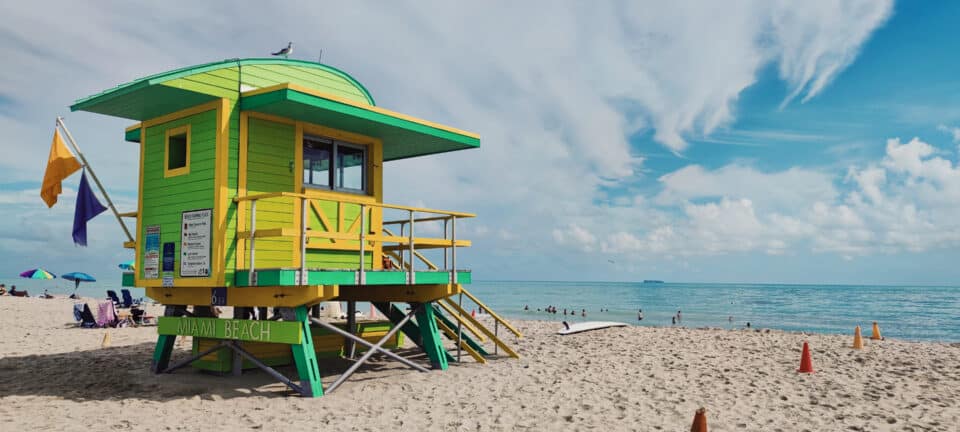
Housing stock is where Bal Harbour quotes really diverge. West of Collins Avenue, the gated residential section — streets like Bal Bay Drive — was platted when the village incorporated in 1946, and original 1950s- and 1960s-built homes now sit beside lot-by-lot rebuilds; carriers price those eras as cohorts, by construction type and each cohort’s claims record, so a concrete-block original and a ground-up rebuild on the same street can quote very differently, with documented roof age priced inside that driver. Along Collins, the towers span six decades: the 1960s-era Harbour House (since extensively renovated), the 1970s-built Kenilworth and Balmoral, Majestic Tower from 1998, then Bellini (2005), One Bal Harbour (2007), the St. Regis residences (2012), and Oceana (2016). Unit owners there carry HO-6 policies — which we also write — and should know Florida’s milestone-inspection law (s. 553.899, F.S.) requires structural inspections for buildings three stories and taller, which Miami-Dade officials can set at 25 years for buildings near salt water. For the carrier-by-carrier view across the county, see our Miami-Dade County home insurance carrier guide.
Auto insurance in Bal Harbour, FL
Bal Harbour driving is defined by its geography: Collins Avenue is the island’s single spine, with the Haulover Inlet bridge to the north and 96th Street feeding Kane Concourse (SR 922) west across the Broad Causeway toll bridge to the mainland. Metrobus service does run along Collins, but for most households it doesn’t replace a car — errands, school runs, and mainland commutes all happen behind the wheel, so families here typically run a vehicle per driver, and often high-value ones garaged in tower parking or behind the gate.
Those corridors also carry heavy visitor and shopper traffic around Bal Harbour Shops and Haulover Park, which shapes how we quote. We recommend at least 100/300 in liability limits — the level leasing companies typically require — with higher limits where they fit your picture, and uninsured/underinsured motorist (UM/UIM) coverage added, because a share of the drivers around you on A1A carry thin coverage or none. For households with real assets behind them, an umbrella policy is the opportunity to add a meaningful layer above those limits — more on that below.
Because we quote home and auto across the same carrier lineup, bundling is usually worth pricing: several of our carriers apply same-agency, multi-policy discounts, and one review catches gaps between the policies instead of leaving them to chance.
Flood insurance in Bal Harbour, FL
In Bal Harbour the flood question is never whether to carry coverage — it’s how much. Standard homeowners policies exclude flood damage (a few carriers offer optional flood endorsements — never automatic), so it’s always a separate decision. Much of the village is mapped in FEMA’s AE zone, which means lenders generally require flood insurance here, and seasonal king tides remind the island every fall that water doesn’t wait for a named storm. During Hurricane Irma, surge pushed 3–5 feet of water along the Biscayne Bay shoreline — including into areas well beyond mapped high-risk zones — which is the county-wide lesson: flooding is decided by a property’s immediate surroundings, its elevation relative to the lots and streets around it, and how the ground drains, not by a line on a map.
Pricing follows the same logic. Under FEMA’s Risk Rating 2.0, an NFIP premium is driven by distance to the flooding source — and here that’s the Atlantic on one side and Indian Creek on the other — plus rebuild cost and the home’s elevation and first-floor height, not the zone letter; most existing NFIP policies also carry an 18% annual cap on increases under the 2014 Homeowner Flood Insurance Affordability Act. Bal Harbour participates in FEMA’s Community Rating System, which can discount NFIP premiums for village policyholders. The NFIP tops out at $250,000 for the building and $100,000 for contents — figures that fall well short of rebuild costs for most Bal Harbour homes — so we regularly quote private flood alongside it, for higher limits or sometimes a better price. Two notes for planning: Citizens ties flood insurance to wind coverage — a statewide requirement phased in through January 1, 2027 — while contents-only condo unit and tenant policies are exempt.
Umbrella insurance in Bal Harbour, FL
An umbrella policy adds a layer of liability protection — typically starting at $1 million — above the limits on your home and auto policies. In Bal Harbour the exposures that make it worth pricing are ordinary ones at larger scale: pools and waterfront lots with private dockage in the residential section, guests and household help on the property, and every licensed driver in the family sharing Collins Avenue with dense visitor traffic. When the assets behind you exceed your liability limits, the umbrella is what stands between a serious at-fault claim and your balance sheet.
Umbrella carriers require minimum limits on the policies beneath them, and the common asks run higher than most households carry: 250/500 bodily injury or a $300,000 or $500,000 combined single limit on the auto, $300,000 of personal liability on the home, and similar limits on any watercraft or motorcycle, so the umbrella quote and the limits review belong in the same conversation. Priced as part of a bundle, coverage is often more affordable than clients expect, and we’ll tell you plainly whether your situation calls for one.
One Bal Harbour quote request. 20+ Florida homeowners carriers.
Barrier-island placements are where an independent agency proves its value: coastal appetite varies carrier to carrier — Citizens’ personal-residential count in Miami-Dade fell from 168,103 policies at the end of December 2024 to 69,979 by May 31, 2026 as private carriers assumed policies statewide. We compare 20+ Florida homeowners carriers (25+ across our personal lines) on a single request, compare what each is willing to do for your specific address and construction, and give you a straight recommendation.
Want to skip the paperwork? Share your current policies securely through Canopy Connect — it takes about a minute, and we do the comparison from there.