
Homeowners Insurance Bowling Green FL
Cornerstone Insurance is an independent Florida agency, and we compare 20+ Florida homeowners carriers for Bowling Green and Hardee County homes. What moves a premium here is the house itself — the era it was built in, what it’s made of, the rebuild limit on the policy, and the discounts you can document. The Peace River just east of town shapes a separate decision entirely, because flood is its own policy — or endorsement — everywhere in Florida, Bowling Green included. This page covers the whole picture: home, auto, flood, and umbrella.
Independent Florida agency · FL license L061107 · Serving Bowling Green and all 67 Florida counties
What shapes homeowners insurance rates in Bowling Green
Water damage — the claim we actually see most
Ask what damages Bowling Green homes most often and the honest answer isn’t a hurricane — it’s water from inside the house. A supply line lets go behind a washing machine, a water heater rusts through, a drain fitting under a slab weeps for months before anyone notices. These plumbing and appliance failures are the claims we handle most across Hardee County, and they’re the reason we encourage every client to carry as much water-damage coverage as they can qualify for. Qualify is the operative word: prior water losses, the age of the home, and the type and age of its plumbing can limit — or with some carriers exclude — water coverage on a quote. In a town where more than half the county’s homes predate 1990, plumbing vintage is a genuine underwriting question, not a formality.
There’s an upside to plan for, too. Several of the carriers we represent offer credits for automatic water shut-off valves and leak-detection devices, and each of our 20+ carriers treats water risk differently — one may surcharge the same house another writes at standard rates. That spread is exactly why an independent agency earns its keep here. And while fire claims are far less frequent, they’re the most severe losses we see, which is why we check the rebuild limit on every quote instead of assuming it.
Wind — summer thunderstorms first, hurricanes second
The wind that touches Bowling Green roofs most years isn’t tropical. It’s the summer thunderstorm season — straight-line gusts, hail, and lightning that Florida’s interior generates from June into September. That’s the wear-and-tear wind that ages shingles and drives the routine claims. The named-storm history is real but rarer: Hurricane Charley crossed inland Hardee County at Category 4 strength on August 13, 2004, producing a 147-mph gust in Wauchula and destroying about 1,400 homes countywide, and Hurricane Ian’s 2022 rains pushed the Peace River basin to record levels. A wind-mitigation inspection (Florida form OIR-B1-1802, valid five years) documents the roof-to-wall connections and roof geometry that can meaningfully cut the wind portion of a premium — on many Bowling Green homes it’s the single biggest discount available.
Sinkholes — what’s actually in a Hardee County policy
Hardee County borders the Tampa-corridor counties where Florida’s sinkhole claims concentrated, so Bowling Green buyers often arrive with questions. Hardee’s own record is modest — county documentation shows only a handful of minor incidents across six decades, just two deeper than five feet. Here’s what the law provides: every admitted Florida homeowners policy automatically includes catastrophic ground cover collapse coverage under s. 627.706, Florida Statutes. Broader sinkhole loss coverage must be offered for an additional premium, but carriers don’t have to approve it — an inspection can be required first, and approved endorsements typically carry a deductible of 10% of the dwelling limit, not 10% of the claim. Florida’s SB-408 five-part structural-damage test also means cosmetic cracking doesn’t qualify, and paid sinkhole claims are recorded with the county clerk, permanently searchable by future buyers. Our framing for Bowling Green: know your risk. If you’re buying an older home and the ground concerns you, a pre-purchase sinkhole inspection answers more than an endorsement application will — and we’ll tell you straight what is and isn’t realistic to place.
The housing stock — rail-town grid, 1970s cohort, and manufactured homes
Bowling Green was platted as a railroad town in 1884 and incorporated in 1927, and the housing stock still tells that story: older frame and mid-century block homes on the grid streets off Main Street and US 17, scattered newer construction, and acreage properties running out toward Fort Green and Popash. A lot of those rural parcels carry manufactured homes, and our Florida manufactured home insurance guide covers that market. Countywide, 53.5% of Hardee’s homes were built before 1990 — the 1970s were the single largest construction decade — and only 9.3% date from 2010 or later. Carriers price those eras as cohorts, not on a straight line: each building era gets judged on its construction type and that cohort’s claims record, so a solid 1950s concrete-block house can genuinely outperform a fast-built 1980s frame one. Documented roof age lives inside that same driver — carriers price the roof they can see paperwork for, which is why permits and inspection reports are worth digging out before we quote. Manufactured homes matter here more than almost anywhere in Florida: they’re 27.1% of Hardee’s housing stock, about three and a half times the state share, and they’re written on distinct policy forms with tie-down and HUD wind-standard requirements. We place those too. For the county-wide carrier picture, see our guide to the best home insurance companies in Hardee County.
Acreage, animals, and the mini-farm question
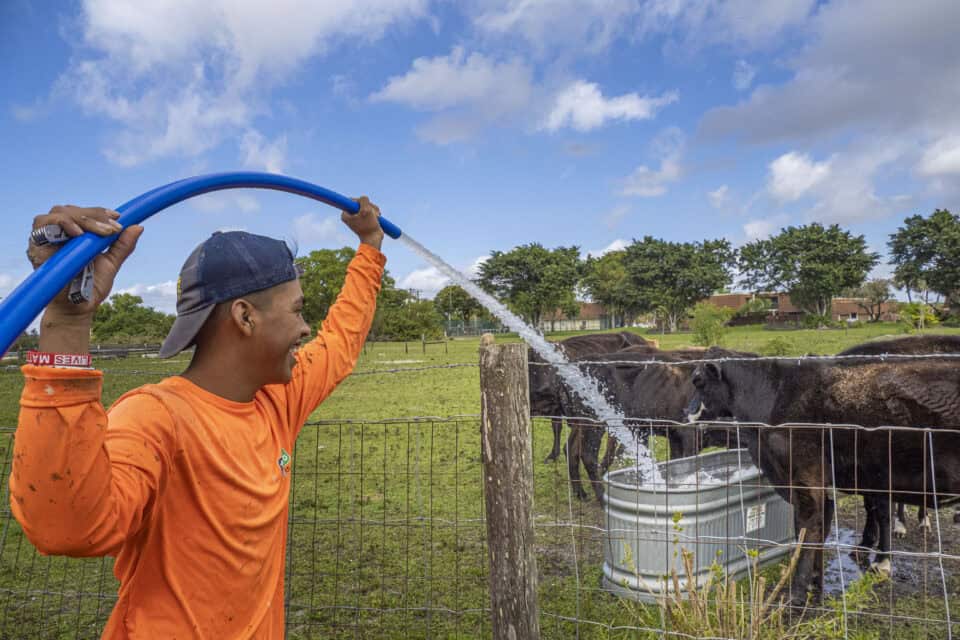
This is citrus and cattle country, and plenty of Bowling Green properties come with a barn, a few head of livestock, or horses for the family. Personal-use animals like these can often stay within a homeowners program through mini-farm endorsements available from some of our carriers — availability and terms vary, so we confirm it per quote rather than promise it. Once the operation turns commercial — boarding, training, breeding, or selling — it needs commercial coverage, and we’ll refer you to the right market for that piece while keeping the home and autos with us.
Auto insurance in Bowling Green
US 17 is Bowling Green’s spine — south to Wauchula and Zolfo Springs, north to Fort Meade and Bartow — and SR 62 strikes west from just south of town toward Duette and Parrish. Those are two-lane roads shared with agricultural equipment, livestock trailers, and the truck traffic a working county generates, and the miles add up because they have to: public transportation in Hardee County is sparse — a registration-based, door-to-door community transportation service plus the regional Heartland Rides network — nothing a working household can build a daily schedule around. Every working adult in a Bowling Green household drives, so most households insure multiple vehicles — pickups, a commuter car, often a teen driver’s first vehicle, and the trailers and ATVs that come with acreage.
For those miles we recommend at least 100/300 in liability limits on every Bowling Green auto quote — the level leasing companies typically require — with higher limits where they fit your situation. We also recommend adding uninsured/underinsured motorist coverage, because on rural highways the other driver’s limits are a coin flip you don’t control. Where a household has real assets or real exposure, an umbrella policy is the opportunity for another layer of protection above both auto and home — more on that below. Bundling home and auto with the same agency usually earns a discount on both sides, and it means one phone number when something goes wrong.
Flood insurance in Bowling Green
The Bowling Green flood question is never whether — it’s how much. Standard homeowners policies exclude flood (a few carriers offer optional flood endorsements — never automatic), so every home here needs some amount of flood protection decided on purpose. Hardee County’s flood exposure is riverine: the Peace River runs just east of town — the USGS keeps a river gauge at Bowling Green — and Paynes Creek meets the river at the town’s southern edge by the state park. Hurricane Ian showed what that basin can do: in 2022 its rains drove the Peace River at Zolfo Springs to a record crest of 27.24 feet, with 15–20 inches falling around Wauchula, and homes 40-plus miles inland flooded that had never flooded before.
Distance from the river doesn’t settle it either, because flooding is decided street by street — by your home’s immediate surroundings, how it sits relative to the lots next door, and how the ground under it drains. A house on the high side of the grid and one two blocks away can have completely different flood realities. That’s also how FEMA prices it: under Risk Rating 2.0, premiums are built from your distance to a flooding source, the home’s rebuild cost, and its elevation and first-floor height — not from a zone letter on a map. Away from the river itself, that math often makes Bowling Green flood premiums pleasantly reasonable, which is worth knowing before assuming it’s unaffordable.
NFIP policies cover up to $250,000 on the building and $100,000 on contents, private flood markets can go higher, and annual increases on most existing NFIP policies are capped at 18% under the 2014 Homeowner Flood Insurance Affordability Act. Two more planning notes: your lender not requiring flood insurance only means the mapped zone didn’t trigger the mortgage rule — and Citizens ties flood insurance to wind coverage, a statewide requirement phased in through January 1, 2027.
Umbrella insurance in Bowling Green
An umbrella policy is designed to sit above the liability limits on your home and auto policies — typically sold in $1 million increments — and it exists for the day a claim outruns those underlying limits. Bowling Green life carries the kinds of exposure that make one worth pricing: daily miles on two-lane highways, teen drivers, pools, dogs, horses and livestock on acreage, and — for the many families here who own their homes outright — equity that a judgment could reach. An umbrella is designed to help protect what you’ve built, subject to the policy’s terms and its required underlying limits, which is why we quote it as part of the whole package rather than as an afterthought. The premium for the first million is usually smaller than people expect.
How we compare the market for Bowling Green
Cornerstone is an independent Florida agency — we represent many carriers rather than one — and we quote Bowling Green homes across 20+ Florida homeowners carriers and 25+ carriers across our personal lines. That matters in a small market like Hardee County, where the difference between one carrier’s appetite and another’s is often the whole ballgame. Hardee’s own record shows how much that appetite can change: Citizens, the state-backed insurer, fell from 297 Hardee County policies at the end of 2024 to 135 by May 31, 2026, as private carriers took policies back. When the market moves like that, homes that had one option gain several — and we re-shop so you don’t have to start over.
Already insured? Share your current policies in about a minute through Canopy Connect and we’ll quote apples-to-apples: app.usecanopy.com/c/weprotectyourfamily. One agency, one phone number, every renewal reviewed.