
Homeowners Insurance in El Portal, FL
Cornerstone Insurance is an independent Florida agency, and we compare 20+ Florida homeowners carriers for El Portal and Miami-Dade homes. Most of this village was platted in the 1920s land boom, and carriers price those early building eras very differently — which is why one application across many markets beats calling carriers one at a time. And because flood is its own policy — or endorsement — everywhere in Florida, El Portal included, we quote that alongside the homeowners policy rather than as an afterthought.
Independent Florida agency · FL license L061107 · Call or text 813.920.8181
What Shapes Homeowners Insurance Rates in El Portal
Start with the claim category that actually fills our files: water damage from inside the house. Supply lines, water-heater tanks, washing-machine hoses, and A/C condensate lines fail quietly and do expensive damage, and in a village where a large share of the housing predates 1960, the type and age of the plumbing behind the walls matters as much as the fixture in front of them. Original galvanized supply lines or cast-iron drains can lead some carriers to limit — or in some cases exclude — water-damage coverage, and recent water losses tighten those options further. Our guidance runs the other way: carry as much water-damage protection as your home can qualify for, document any re-pipe or re-plumb work, and ask us about the automatic water shut-off and leak-detection devices that earn discounts with several of our carriers. Every carrier treats interior water differently, which is a real reason to shop 20+ of them. Fire deserves one plain sentence too: it is the least frequent major loss and the most severe one, so the rebuild limit on your policy matters more than any single discount.
The storms that touch El Portal most often aren’t the ones with names. South Florida’s summer pattern delivers near-daily afternoon thunderstorms — lightning, straight-line wind, hard rain, occasional hail — and those storms produce steady roof, fence, and screen-enclosure claims year after year. Named storms are the second layer of the wind story, and here the county’s history is blunt: Hurricane Andrew (1992) devastated southern Miami-Dade, Katrina’s first landfall (Aug. 25, 2005) came near the Miami-Dade/Broward line with 80-mph winds, and Wilma (2005) crossed the county and knocked out power for weeks. That history is also why Miami-Dade and Broward — and only those two counties — make up the Florida Building Code’s High-Velocity Hurricane Zone: Risk Category II structures here are designed to 175-mph three-second-gust winds, and HVHZ-rated impact-resistant products are required in covered work. For a homeowner, the practical takeaway is that documented opening protection and roof attachment are the biggest premium levers you control, captured on a wind-mitigation inspection (form OIR-B1-1802, valid for five years).
Sinkholes get asked about because they make Florida headlines, so here is the honest local answer: Miami-Dade has minimal reported sinkhole history — this is not the Tampa Bay karst belt, and subsidence claims are not a meaningful part of the claims picture we see in El Portal. Every admitted Florida homeowners policy automatically includes catastrophic ground cover collapse coverage by statute, and the fuller sinkhole-loss endorsement question is covered in the FAQ below — including why it is rarely the thing an El Portal buyer should spend underwriting capital on.
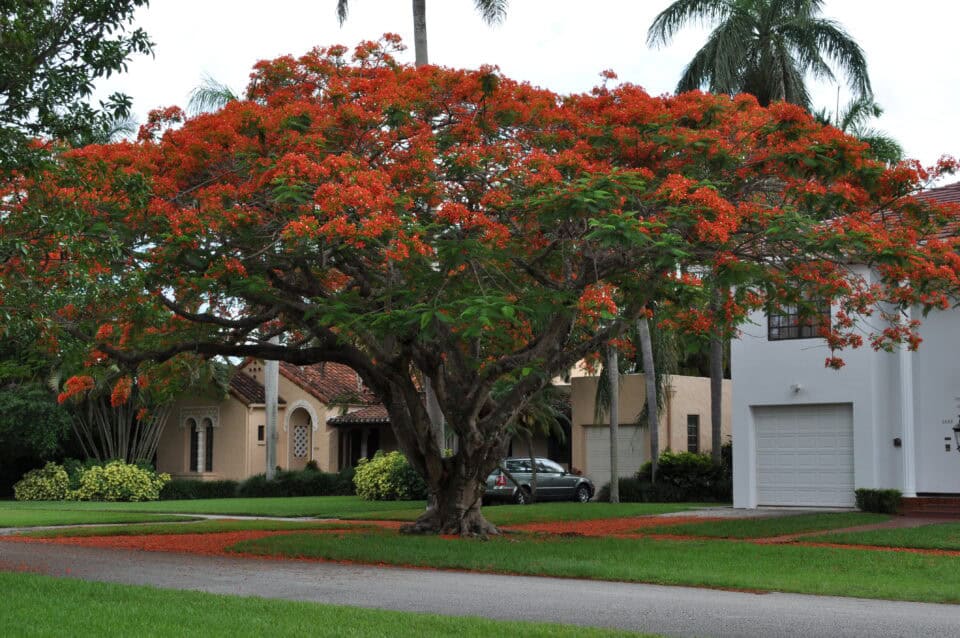
El Portal is a village of roughly 0.4 square miles formed from three 1920s plats — Sherwood Forest, El Jardines, and the original El Portal subdivision — and the housing shows it: Mediterranean- and Tudor-influenced cottages and bungalows from the land-boom years, post-war ranches from the mid-century, and a layer of deep renovations and occasional new builds on lots that mostly run 6,000 to 9,000 square feet. Carriers don’t price age on a straight line; they price building eras as cohorts, weighing each era’s construction type against its claims record — which means a solidly built 1920s masonry cottage with a documented new roof, updated wiring, and re-piped plumbing can quote surprisingly well, while an unrenovated mid-century home with original systems can struggle. Expect a four-point inspection on older homes, and know that documented roof age is priced directly: carriers rate 1920s-built and 1950s-built homes on what the paperwork proves, not on curb appeal. For the county-wide carrier picture behind all of this, see our guide to the best home insurance companies in Miami-Dade County.
Auto Insurance in El Portal, FL
El Portal sits in the middle of urban Miami-Dade driving: Biscayne Boulevard and I-95 minutes away, NE 2nd Avenue running straight through the village, and dense stop-and-go traffic in every direction. Metrobus does serve the NE 2nd Avenue and Biscayne corridors, so this isn’t a place with no transit — but for households commuting across the county in different directions, the practical reality is still two or more vehicles per driveway, and each additional car makes the multi-car and bundle math work harder in your favor.
On limits, we recommend at least 100/300 in liability limits — the level leasing companies typically require — with higher limits where they fit your assets and situation. Just as important in this market: uninsured/underinsured motorist (UM/UIM) coverage. Insurance Research Council studies have consistently placed Florida among the states with the largest share of uninsured drivers, and in heavy Miami traffic, UM/UIM is designed to help protect your household when the at-fault driver has little or nothing. We quote it on, not as an afterthought.
Writing home and auto through the same independent agency usually earns a same-agency bundle discount with several carriers, and it sets up the next step: once your underlying auto and home liability limits are in place, an umbrella policy becomes the opportunity to add a meaningful layer of protection over both — more on that below.
Flood Insurance in El Portal, FL
Flooding is decided block by block — by a home’s immediate surroundings, how it sits relative to the properties next to it, and how the ground underneath drains — and it happens well away from any coastline. In El Portal, there’s a specific mechanism worth understanding: the tidal Little River (the C-7 canal) runs along the village, and the water management district’s S-27 gate, at the point where the canal meets Biscayne Bay, must close against high tides to keep seawater out. When that gate is closed and heavy rain falls, the water draining into the canal has nowhere to go — it backs up toward streets and yards. That is why the question for an El Portal homeowner is never whether to carry flood coverage; it’s how much.
Standard homeowners policies exclude flood — a few carriers offer optional flood endorsements, but never automatically — so flood, including storm surge, is always its own policy or endorsement. The NFIP writes up to $250,000 on the building and $100,000 on contents, and private flood carriers can go higher with different terms; we quote both. Under FEMA’s Risk Rating 2.0, your premium is driven by your home’s distance to a flooding source, its rebuild cost, and its elevation and first-floor height — not by the letter on a flood-zone map — and most existing NFIP policies are protected by an 18% annual increase cap under federal law. For a village bordered by a tidal canal, those pricing inputs usually work out more reasonably than homeowners fear, but you only know by quoting it.
Storm surge deserves one note, not a headline: during Hurricane Irma (2017), the National Hurricane Center documented an average of 3–5 feet of surge along the Biscayne Bay shoreline — El Portal sits upriver of the bay, but the tidal connection through the Little River is exactly why the gate, and the coverage, matter. One scheduling fact to plan around: Citizens ties flood insurance to wind coverage — a statewide requirement phased in through January 1, 2027 — so if your homeowners policy is with Citizens, the flood question is built into the policy itself. We’d rather have that conversation on your terms.
Umbrella Insurance in El Portal, FL
An umbrella policy is a layer of liability protection that sits over both your homeowners and auto liability limits — typically in million-dollar increments — and is designed to respond after those underlying limits are exhausted, subject to the policy’s terms. For the cost of a modest monthly bill, it is usually the cheapest million of protection a household can buy.
The El Portal fit is straightforward. Deeply renovated village homes represent substantial assets worth protecting; backyard pools, dogs, and young drivers are classic liability multipliers; and daily driving on some of Florida’s densest corridors — with cyclists and pedestrians sharing the streets around the village — keeps auto liability the most likely path to a serious claim. If any of those describe your household, an umbrella belongs in the quote conversation.
Umbrella carriers set their own minimum limits on the policies underneath, and most ask for more than the auto floor we recommend: commonly 250/500 bodily injury or a $300,000 or $500,000 combined single limit on the auto, $300,000 of personal liability on the home, and similar limits on any boat or motorcycle policy, so we quote the umbrella and the underlying policies together. Bring us the household picture once and we’ll quote the home, auto, and umbrella as one coordinated program instead of three disconnected policies.
One El Portal Quote Request. 20+ Florida Homeowners Carriers.
We’re an independent Florida agency with a team of agents serving all 67 counties — 20+ Florida homeowners carriers, 25+ across our personal lines — and independence matters more in a village like this one than almost anywhere: when the housing runs from 1920s masonry cottages to gut renovations, no single carrier is the right answer for every home on the block. We match each home’s era, roof documentation, and updates to the carriers that actually want that profile — and we’ll tell you straight when a carrier doesn’t.
The depth of that private market shows up in Citizens’ own numbers: the state-backed insurer counted 168,103 personal-residential policies in Miami-Dade on Dec. 31, 2024 and 69,979 by May 31, 2026 — a roughly 58% decline in 17 months as private carriers assumed policies statewide. If your policy is with Citizens, or has simply renewed on autopilot, a requote across 20+ carriers is a short conversation that can only help. The fastest way to start: share your current coverage securely through Canopy Connect — it takes about a minute and pulls your declarations pages for us — or request a quote and we’ll take it from there.