
Homeowners Insurance in Florida City, FL
Cornerstone Insurance is an independent Florida agency, and we compare 20+ Florida homeowners carriers for Florida City homes. Every quote here starts with how the house is built — this is Florida’s High-Velocity Hurricane Zone, and carriers draw a sharp line between the pre-Andrew block homes on the downtown grid and the impact-glass construction that came after. Flood is its own policy — or an endorsement — everywhere in Florida, Florida City included, and we price it alongside the home rather than leaving it for later.
Free, no obligation — talk to a licensed Florida agent today.
What shapes homeowners insurance rates in Florida City
Hurricanes dominate the headlines, but the claims we handle most often from South Dade homes are water claims: a supply line that lets go behind a washing machine, a water heater that rusts through, an AC condensate line that backs up into a hallway. We encourage every client to carry as much water-damage coverage as they can qualify for — and qualifying is the operative word, because carriers don’t offer it evenly. A water loss in your history, an older home, or aging plumbing — cast-iron drain lines in pre-Andrew houses are the classic example — can limit or even exclude water coverage with some of our markets, while others may write it with a smart water shut-off or leak-detection device and discount the policy for having one. Fire sits at the other end of the spectrum: far less frequent, but the most severe loss a homeowner can face, which is why we check the rebuild-cost limit on every quote instead of assuming the old number still holds.
The everyday wind story in Florida City isn’t a named storm — it’s the summer thunderstorm cycle, the afternoon storms that build over the Everglades and roll east across South Dade with straight-line wind, lightning, and the occasional hail core. Those storms produce a steady stream of roof, fence, and screen-enclosure claims year after year. Named storms are the second chapter, and here it’s a defining one: on August 24, 1992, Hurricane Andrew came ashore near Homestead as a Category 5, and Florida City was among the most heavily damaged communities in the state. What followed reshaped construction across Florida. Miami-Dade and Broward make up the state’s only High-Velocity Hurricane Zone — Risk Category II structures here are designed to 175-mph three-second-gust winds, and openings require HVHZ-rated impact protection. That history works in your favor at quote time: a wind-mitigation inspection documenting your roof shape, deck attachment, and opening protection is often the single largest discount available on a Florida City policy.
Carriers read Florida City’s housing stock in cohorts, and the cohorts here are unusually distinct. The original grid around Palm Drive and the numbered avenues holds concrete-block homes that predate Andrew; much of the rest of the city was rebuilt after 1992 under progressively stricter rules — first the strengthened South Florida code of the 1990s, then the statewide Florida Building Code adopted in 2002; and the newest cohort is the builder communities that filled in around the edges — Palm Cay, Parker Pointe, Vista Sol, and Baywood by D.R. Horton, Le Jardine and Sunscapes by Lennar among the projects that filled in the city’s newer blocks. Carriers don’t price age on a straight line — they price each building era by its construction type and that era’s claims record, so a solid 1960s block home on the grid can quote surprisingly well against a fast-built home from a weaker code period. Documented roof age lives inside that same driver: carriers price what your roof paperwork proves, which is why we ask for the permit or invoice on every 1990s-built home we quote. For the carrier-by-carrier view across the county, see our Miami-Dade County home insurance guide.
Sinkholes come up less in Florida City than almost anywhere we work — reported subsidence incidents in Miami-Dade are few compared with the karst belt of west-central Florida, and we’ll say that plainly rather than sell you worry. Every admitted Florida policy automatically includes catastrophic ground cover collapse coverage, and the full picture — what the optional sinkhole endorsement is, why approval isn’t guaranteed, and what a paid claim means for a property’s record — is in the FAQ below.
One more note for properties on the city’s agricultural edge, out toward Krome Avenue where South Dade’s farmland begins: if you keep a few personal-use animals on acreage, some carriers can accommodate that through mini-farm endorsements — some, not all, and the details matter. Anything commercial — boarding, training, breeding, or selling — falls outside personal lines, and we’ll refer you to the right market rather than pretend a homeowners policy stretches that far.
Auto insurance in Florida City, FL
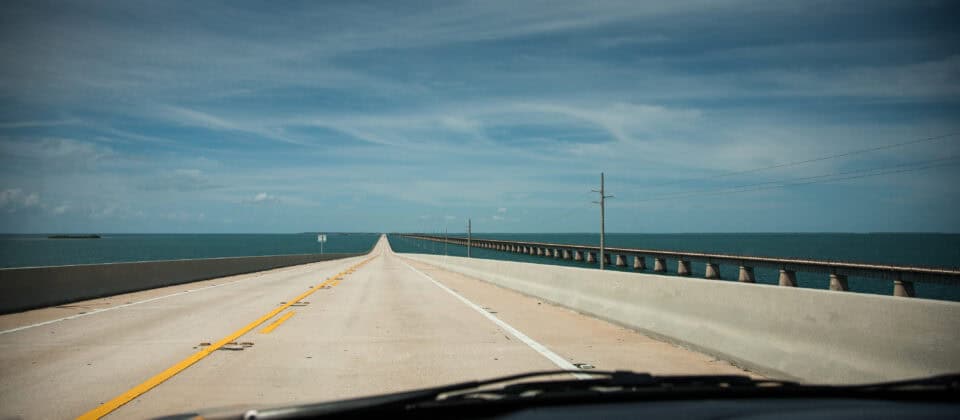
Florida City is where South Florida’s road network funnels down to a point: the Turnpike’s Homestead Extension ends at US-1 here, Krome Avenue reaches its southern end here, and everything bound for the Keys passes through town before the 18-Mile Stretch to Key Largo. That mix — heavy through-traffic, farm trucks off the agricultural land west of town, and visitors navigating unfamiliar intersections on the way to Everglades or Biscayne National Park — is exactly the environment where a bare-minimum policy leaves a household exposed.
To be fair, Florida City has more transit than most small Florida cities — the South Dade TransitWay’s bus rapid transit runs roughly 20 miles from Dadeland South to its final stop at SW 344th Street. But one corridor pointed north toward Miami doesn’t carry a working household through daily life in South Dade, so most families here still run a vehicle per driving adult, and many add a work truck or a trailer for the boat.
Our recommendation is consistent: quote at least 100/300 bodily-injury liability — the level leasing companies typically require — and treat it as the floor for consideration, not the ceiling. We’ll show higher limits where they fit the household, and we add uninsured/underinsured motorist coverage to the conversation every time, because on roads carrying this much transient traffic, the driver who hits you may be carrying Florida’s minimums or nothing at all. For households with real assets or teen drivers, the next step up is an umbrella — more on that below.
Bundling home and auto with the same agency usually earns a discount on both sides, and it means one office answers for everything when something goes wrong. We quote auto across our carrier lineup the same way we quote homes — several markets, one conversation.
Flood insurance in Florida City, FL
Florida City sits on some of the flattest, lowest ground in Miami-Dade — the coastal plain between the Everglades and Biscayne Bay, where drainage is an engineered system, not a slope. The C-111 canal, authorized by the Flood Control Act of 1962 to protect South Dade’s farmland, carries floodwater along the eastern boundary of Everglades National Park toward Taylor Slough, and a lattice of smaller canals does the local work. On terrain like this, the question is never whether you need flood coverage — it’s how much. Everyone in Florida City needs some.
Whether a particular home floods is decided at a much smaller scale than any map suggests: the home’s immediate surroundings, its elevation relative to the lots beside it, the soil underneath, and how quickly that specific block sheds a stalled summer downpour. Homes far from any canal flood in cloudbursts; homes beside one stay dry for decades. Storm surge is part of the file here too — the National Hurricane Center documented 3 to 5 feet of surge inundation along the Biscayne Bay shoreline from Homestead to downtown Miami during Hurricane Irma in 2017, and some of it reached beyond mapped high-risk zones — but surge is one line in the assessment, not the headline. Rain on flat ground is the everyday risk.
A standard homeowners policy excludes flood — rising water from outside the home — regardless of what put the water there. A few carriers offer an optional flood endorsement on the homeowners policy itself, but it’s never automatic and never assumed; it has to be requested, quoted, and confirmed. Otherwise flood is its own policy, through the National Flood Insurance Program or the private flood market.
What you’ll pay has less to do with your flood zone than people expect. Under FEMA’s Risk Rating 2.0, NFIP premiums are built from the property itself — distance to the nearest flooding source, the cost to rebuild, and the home’s elevation and first-floor height — and most existing NFIP policies can’t increase more than 18% per year under the 2014 Homeowner Flood Insurance Affordability Act. NFIP coverage tops out at $250,000 for the building and $100,000 for contents; where a Florida City home needs more, private flood carriers can layer above it or replace it. One scheduling note worth knowing: Citizens ties flood insurance to wind coverage — a statewide requirement phased in through January 1, 2027.
We price flood by address, alongside the home quote, so you can see the whole picture in one conversation.
Umbrella insurance in Florida City, FL
An umbrella policy adds a layer of liability protection above the limits on your home and auto policies — typically starting at $1 million — designed to help when a serious claim runs past what those policies can pay. It’s some of the least expensive coverage per dollar of protection in the personal lines world.
The Florida City liability picture is ordinary in the best sense: backyard pools, dogs, teen drivers sharing the roads with Keys-bound traffic, boats trailered down US-1 on weekends, and — for the many local owners who rent out a property — tenants and guests on premises. Any one of those can generate a claim that outruns a standard liability limit.
If we’re already quoting your home and auto, adding an umbrella review costs nothing and usually takes minutes, because the underlying limits are already in front of us. It’s the natural last step of the 100/300 conversation from the auto section above.
One Florida City quote request. 20+ Florida homeowners carriers.
As an independent Florida agency, we represent many carriers rather than one. One quote request puts your Florida City home in front of 20+ Florida homeowners carriers — and 25+ carriers across our personal lines — so the market competes for your business instead of you shopping it one call at a time.
That matters in Miami-Dade more than most places. Between December 31, 2024 and May 31, 2026, Citizens’ personal-residential policy count in the county fell from 168,103 to 69,979 — a reduction of roughly 58% in seventeen months as private carriers took on policies. When carriers compete for South Dade homes, the household that re-shops is the household that benefits.
Want the fastest start? Share your current coverage securely through Canopy Connect — it takes about a minute, and we’ll rebuild your quote from what you actually have instead of a guess.
Florida City insurance questions we hear most
What drives the cost of homeowners insurance in Florida City?
Seven things do most of the work. First, the age of the home — priced in building-era cohorts, not on a straight line: carriers rate each era by its construction type and that cohort’s claims record, which is why a pre-Andrew concrete-block home on the downtown grid can outperform a fast-built home from a weaker code period, and why documented roof age (the permit, the invoice) matters so much inside this driver. Second, construction materials — concrete block versus frame, roof shape and covering. Third, your Coverage A rebuild-cost limit: carriers embed replacement-cost estimators to gauge the rebuild-cost limit on every quote rather than guessing, so the limit tracks real South Dade construction costs. Fourth, endorsements like replacement cost on contents and law & ordinance. Fifth, wind-mitigation discounts — especially valuable in the High-Velocity Hurricane Zone, where documented opening protection and roof attachment earn real credits. Sixth, the miscellaneous discounts: gated community, monitored alarm, insurance score, water leak-detection devices. Seventh, the area’s historic and actual loss data. Each of our 20+ carriers weighs these differently, which is exactly why shopping the market changes the answer.
Will a prior claim raise my homeowners rate in Florida City?
Not the way most people assume. A prior claim does not raise your property rate itself — what it does is narrow which carriers will offer you a policy, and it costs you the claims-free discount, which typically runs 2–10%. The practical effect is that after a claim, the shopping matters more, not less: fewer markets will quote you, so finding the ones that will — at their best terms — is the job. That’s what an independent agency with 20+ homeowners carriers is for.
How much flood insurance do I actually need in Florida City?
Start from the premise that everyone on ground this flat and low needs some flood coverage — the real question is how much. The number depends on your rebuild cost, your contents, and your tolerance for a gap: NFIP policies cap at $250,000 for the building and $100,000 for contents, and private flood carriers can go higher where the home calls for it. Pricing under Risk Rating 2.0 is driven by your property’s own characteristics — distance to the nearest flooding source, rebuild cost, elevation and first-floor height — not simply by which zone a map puts you in, and most existing NFIP policies can’t rise more than 18% a year. Remember the coverage boundary too: a standard homeowners policy excludes flood entirely, and while a few carriers offer an optional flood endorsement, it’s never automatic. We price flood by address, so bring us yours.
Does homeowners insurance in Florida City cover sinkholes?
Two different coverages get mixed up here. Every admitted Florida policy automatically includes catastrophic ground cover collapse — that’s statute, section 627.706(1)(a) — covering the severe scenario where the ground opens and the home is condemned. Separate sinkhole loss coverage is something carriers must offer for additional premium, but offering isn’t approving: carriers can require an inspection first, they often decline, and in Florida’s sinkhole-prone counties many homes can’t get the endorsement approved at all. Where it is approved, it typically carries a deductible of 10% of your dwelling limit — the dwelling limit, not the claim — and Florida’s SB-408 five-part structural-damage definition is strict, so cosmetic cracking doesn’t qualify. A paid sinkhole claim is also recorded with the county clerk and permanently searchable, and sellers must disclose it.
The honest Florida City context: reported subsidence incidents in Miami-Dade are few compared with west-central Florida, so this is a smaller part of the conversation here than it would be in Tampa Bay. If you’re buying and want certainty about a specific property, a pre-purchase sinkhole inspection is the right tool. Either way, we’ll tell you straight what is and isn’t realistic to place.
Do I really need umbrella insurance in Florida City?
Need is personal; the math is not. An umbrella adds $1 million or more of liability protection above your home and auto limits for a comparatively small premium, and it’s designed to help when a serious claim — a pool accident, a dog bite, a bad crash involving your teen driver — runs past what the underlying policies can pay. If you own property you rent out, have drivers under 25, or have assets worth protecting, it deserves a serious look. We review it as part of every home-and-auto quote, so the answer costs you nothing to find out.
Florida City rebuilt after Andrew — what does windstorm coverage look like here?
Windstorm coverage is typically part of a standard homeowners policy in Florida, but it works differently than other perils: hurricane losses carry their own deductible, usually set as a percentage of your dwelling limit (commonly 2%, 5%, or 10%) rather than a flat dollar amount (though some carriers do offer flat-dollar hurricane deductibles, depending on how far the home is from the coast), and that choice moves your premium meaningfully. Florida City’s post-Andrew reality helps you here — the city sits in Florida’s only High-Velocity Hurricane Zone, where Risk Category II structures are designed to 175-mph three-second-gust winds and openings require HVHZ-rated impact protection, and homes built or retrofitted to those standards earn substantial wind-mitigation credits. A wind-mitigation inspection runs a couple hundred dollars and frequently pays for itself in the first year. When we quote your home, we’ll show the hurricane deductible options side by side so the trade-off is a decision, not a surprise.