
Homeowners Insurance in Indian Creek, FL
Cornerstone Insurance is an independent Florida agency, and we compare 20+ Florida homeowners carriers for Miami-Dade homes. On an island where every estate lot fronts Biscayne Bay, the creek, or the lake, remember that flood is its own policy — or endorsement — everywhere in Florida, Indian Creek included.
Independent Florida agency · License L061107 · Home, auto, flood & umbrella statewide
Homeowners insurance built for Indian Creek estates
Across our Florida book, the claim we handle most often has nothing to do with hurricanes — it’s water escaping inside the house. At estate scale that means long supply runs, multiple laundry and bar areas, aging water heaters, and A/C condensate lines that can leak inside a wall for days before anyone notices, especially in a home that sits quiet part of the year. We encourage every client to carry as much water-damage coverage as they can qualify for, because recent water losses, the age of the home, and the type and age of its plumbing can limit — or with some carriers exclude — water coverage entirely, and each carrier draws those lines differently. Whole-home automatic water shut-off systems earn credits with several of the carriers we quote, and in a seasonal residence they do far more than earn a discount. Fire sits at the other end of the curve: the claim we see least often and the most severe when it happens, which is why the rebuild limit deserves more scrutiny than the premium.
The wind claims that show up most regularly aren’t from named storms — they’re from ordinary summer thunderstorms crossing Biscayne Bay with straight-line gusts, hail, and lightning. Hurricanes are the reason the building code here is what it is: Hurricane Andrew came ashore near Homestead on August 24, 1992 as a Category 5, and in 2005 Hurricane Katrina crossed Miami-Dade with 80-mph winds. Miami-Dade and Broward — and only those two — make up the Florida Building Code’s High-Velocity Hurricane Zone, where impact-rated products are required and standard structures in Miami-Dade are designed to 175-mph three-second-gust winds. That’s why a post-2002 HVHZ rebuild is a genuine underwriting differentiator when we compare your home.
The island itself was dredged into existence in the early 1900s and stayed mangrove until 1928, when the country club and its estate lots were laid out; the village incorporated on May 17, 1939 with seventeen residents. Roughly forty perimeter lots ring the golf course along a single village road, and the housing stock runs from club-era originals that have passed through generations of renovation to teardown rebuilds engineered to the current HVHZ standard. Carriers price building eras as cohorts — construction type plus that cohort’s claims record — so a substantially renovated 1930s-built home and a new concrete-and-glass rebuild can land in very different places, and documented roof age is priced inside that same driver. Our Miami-Dade County carrier guide covers how we rank the carriers behind those quotes.
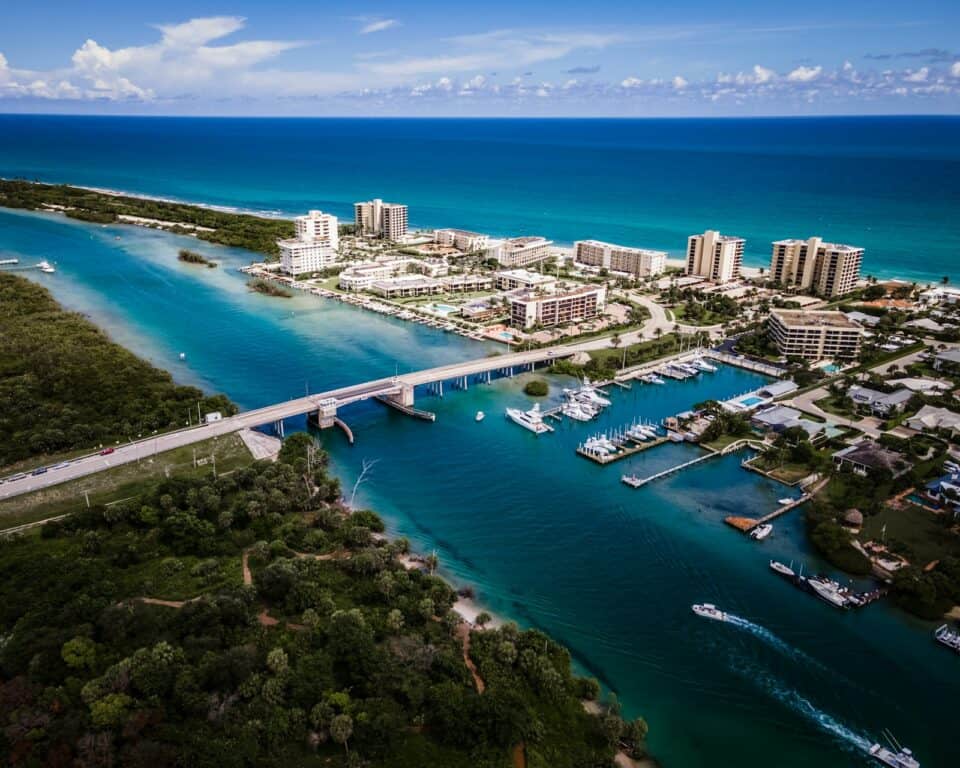
Sinkholes are one Florida worry Indian Creek largely gets to skip: Miami-Dade sits outside the state’s sinkhole-prone karst belt, and reported activity in the county is minimal. Every admitted Florida policy still automatically includes catastrophic ground cover collapse coverage, so the severe, statutorily defined event is covered without any endorsement — the details are in the FAQ below.
One thing we’ll say plainly: at Indian Creek values, the dwelling limit does the heavy lifting. Carriers embed replacement-cost estimators to gauge the rebuild-cost limit on every quote rather than guessing, and that estimate — worked up with your agent from this specific home’s construction, upgrades, and scope — is what decides where the account fits, not the address. High-net-worth specialty programs price from rich replacement estimates, so a padded number quietly costs premium every year, while many admitted Florida carriers also write HO-5 policies with extended replacement cost and other high-value-style endorsements at better premiums. We work both sides of that line from one honest rebuild figure, and we’ll tell you straight what is and isn’t realistic to place.
Auto insurance in Indian Creek
The only way on or off the island is the single bridge from Surfside at 91st Street, past the village’s police checkpoint. Miami-Dade’s county bus network serves the Collins Avenue corridor on the neighboring barrier island, but no route crosses that bridge — so every trip starts behind a wheel, and households here typically run several vehicles between family members, seasonal cars, and whatever lives in the garage for the fun of it.
For liability limits, we recommend at least 100/300 in liability limits — it’s the level leasing companies typically require — with higher limits where they fit and uninsured/underinsured motorist coverage added, because a state-minimum driver on the causeway doesn’t carry enough to touch a serious injury claim. From there, an umbrella policy is the natural next layer, and it’s worth reading the umbrella section below with your vehicles in mind. Bundling home and auto with the same agency also unlocks multi-policy discounts most carriers reserve for exactly this situation.
Flood insurance in Indian Creek
Indian Creek is bordered by Biscayne Bay to the west, the Indian Creek waterway to the south and east, and Indian Creek Lake to the north — there is no lot on the island that doesn’t front water. During Hurricane Irma in 2017, the National Hurricane Center documented 3 to 5 feet of surge inundation along Miami-Dade’s Biscayne Bay shoreline from Homestead to downtown Miami, with water pushing a block or two inland in places. Even here, flooding is ultimately decided house by house: the home’s immediate surroundings, its elevation relative to the neighboring properties, its first-floor height, and how the ground drains matter more than any line on a map.
Standard homeowners policies exclude flood — a few carriers offer optional flood endorsements, but coverage is never automatic. The federal NFIP program caps out at $250,000 for the building and $100,000 for contents, which against an Indian Creek rebuild is a rounding error; the real conversation here is private and excess flood coverage layered to a limit that actually reflects the home. Under the NFIP’s Risk Rating 2.0 pricing, premiums are driven by distance to the flooding source, rebuild cost, and elevation and first-floor height — not simply the flood zone letter — and most existing NFIP policies are protected by an 18% annual increase cap under federal law.
So the question in Indian Creek is never whether to carry flood coverage — it’s how much, and through which combination of markets. Note also that Citizens ties flood insurance to wind coverage — a statewide requirement phased in through January 1, 2027. We quote NFIP and private flood side by side and structure the layers with you.
Umbrella insurance in Indian Creek
Liability exposure scales with what there is to lose, and on this island there is a great deal to lose. Pools, docks and the boats tied to them, multiple drivers and vehicles, guests, and people working on the property all create ways a single incident can turn into a claim that blows past the liability limits on a home or auto policy — and households with visible assets tend to attract larger demands when something goes wrong.
A personal umbrella policy is designed to add a layer of liability protection above your underlying home and auto limits, typically in million-dollar increments, subject to the policy’s own terms and its requirements for those underlying limits. For what it adds in protection, it’s usually one of the least expensive policies we quote, and at Indian Creek asset levels we’d want every client at least to see the numbers before deciding.
One application, 20+ Florida homeowners carriers
We’re an independent Florida agency — a team serving all 67 counties — so we represent many carriers rather than one. One application lets us shop 20+ Florida homeowners carriers, and 25+ carriers across our personal lines for auto, flood, umbrella, and more.
For a home like yours, that shopping includes an honest read on which markets will actually compete for it — admitted Florida carriers, high-net-worth programs, or surplus lines — and what each trade-off means. The fastest way to start is to share your current coverage through Canopy Connect: securely link your existing policies in about a minute, and we’ll take it from there.