
Homeowners Insurance in Jupiter Island, FL
We’re an independent Florida agency — a team working the whole state — and we compare your home across 20+ Florida homeowners carriers instead of defending one company’s rate. Every address in town shares the same barrier-island exposure, so what actually separates quotes here is the structure itself: the era it was built, its materials, the Coverage A it takes to rebuild it, and the discounts you can document. And because flood is its own policy — or endorsement — everywhere in Florida, Jupiter Island included, we quote it alongside the homeowners policy instead of leaving it for later.
Free, no obligation — talk to a licensed Florida agent today.
What shapes homeowners insurance rates on Jupiter Island
Across our Florida book, the claims we handle most often on homes like these aren’t hurricane claims — they’re water from inside the house: a failed supply line, a water heater letting go, an A/C condensate line backing up into a ceiling. The town’s own profile counts roughly 820 year-round residents against a seasonal population near 2,000, and that calendar raises the stakes — a large share of island homes sit closed for months while the plumbing stays pressurized, and a slow leak in an empty house does its damage uninterrupted. We encourage clients to carry as much water-damage coverage as they can qualify for, because recent water losses, the age of the home, and the type and age of its plumbing can limit — or even exclude — water coverage with some carriers. An automatic water shut-off or leak-detection system earns a genuine discount with several of our carriers, and on a seasonally occupied island it’s hard to think of a discount that earns its keep better. Fire claims are rarer here, but they’re the most severe losses we see, which is why the rebuild limit deserves at least as much attention as the premium.
Wind on the island splits in two. The everyday version is the summer thunderstorm cycle — wind, hail, and lightning through the wet season, and the source of far more claims than any named storm. The named-storm record is real, dated history: Hurricane Frances came ashore at the southern end of Hutchinson Island as a Category 2 on September 5, 2004, and Hurricane Jeanne made landfall at virtually the same spot three weeks later with winds estimated near 120 mph — both just up the coast from Jupiter Island. Hurricane Nicole’s November 2022 landfall near Vero Beach pushed flooding into riverfront areas near Stuart from well to the north. What you control is documentation: opening protection, roof shape, and roof-to-wall attachments earn wind-mitigation credits recorded on the OIR-B1-1802 inspection form, generally valid for five years — and against estate-scale Coverage A, those credits are real money.
Sinkholes are mostly an inland-Florida story, and we’ll say so honestly. A WPTV analysis of state-tracked sinkhole and subsidence data found just 16 of roughly 27,000 incidents statewide came from the five-county region that includes Martin — and the ground under the island’s ocean side is dune sand over Anastasia limestone, the formation exposed at Blowing Rocks Preserve, not the karst terrain that drives sinkhole counts elsewhere in the state. Every admitted Florida homeowners policy still automatically includes catastrophic ground cover collapse coverage; how the optional full sinkhole endorsement actually works is covered in the FAQ below.
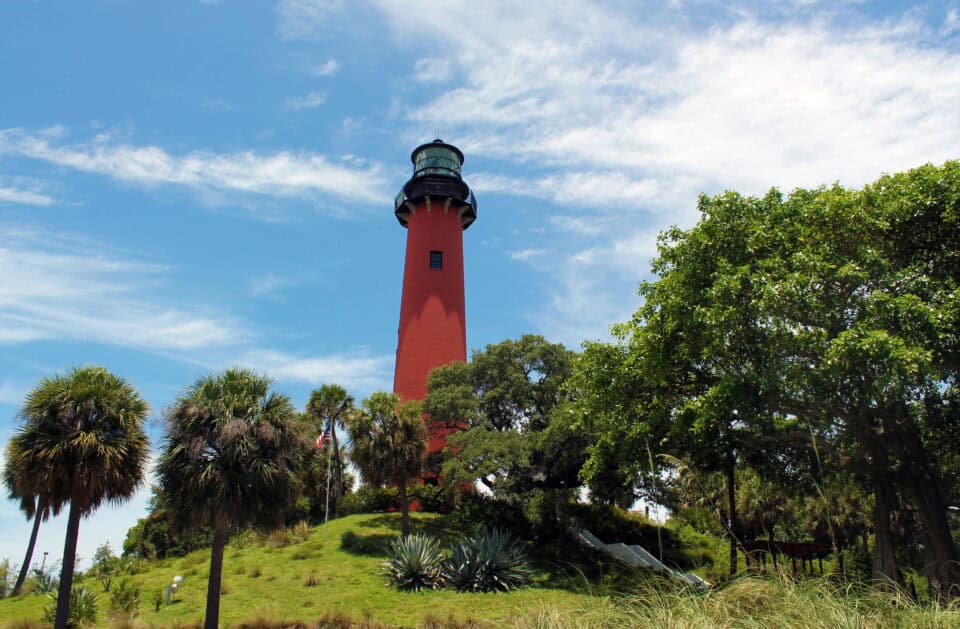
The housing stock reads like the town’s history. The Island Club era of the 1930s and ’40s set the pattern of large lots and low density, incorporation in 1953 locked it in with some of the strictest zoning of any Florida barrier island — Martin County’s countywide four-story, 40-foot height cap reinforces it — and the decades since have layered mid-century estates, later renovations, and current-code rebuilds along South Beach Road between Blowing Rocks Preserve at the south end and the Hobe Sound National Wildlife Refuge’s 735-acre island tract at the north. Carriers price those eras as cohorts — construction type plus that cohort’s claims record, never a straight age line — so a well-built older estate can genuinely out-quote a newer home with the wrong details. Documented roof age lives inside that same driver: carriers price the roof they can see paperwork for, so permits and inspection reports on 1970s-built and 1980s-built homes are worth their weight at quote time. For the carrier-by-carrier view, see our Martin County best home insurance companies guide.
One more island-specific review point: the shoreline here is managed infrastructure. Residents began building seawalls in the 1950s, and the Town established its Beach Protection District in 1982 — a dedicated taxing district that has funded one of the country’s longest-running beach nourishment programs, with more than twenty nourishment episodes recorded in the national beach-nourishment database. On the policy side, the structures that face that water — seawalls, docks, and other detached structures — are treated very differently from one carrier and form to the next, and the limits involved are typically a fraction of Coverage A. That’s a review conversation to have before a claim, not an assumption to discover after one.
Auto insurance in Jupiter Island, FL
There’s no practical public transportation out here. MARTY, Martin County’s transit system, runs a handful of weekday fixed routes along the mainland corridors — Stuart, US 1 through Hobe Sound, Indiantown — but no route crosses to the island, so every commute, school run, and errand happens by car on two roads: South Beach Road (CR 707) running the length of the island, and Bridge Road (CR 708) over the Hobe Sound Bridge to the mainland and US 1. Households here run multiple vehicles as a matter of course, and the garages often hold more than the daily drivers — collector cars, a truck for the boat, golf carts around the club grounds.
We recommend at least 100/300 in liability limits — that’s the level leasing companies typically require — and for most Jupiter Island households, higher limits fit and are worth carrying. Uninsured/underinsured motorist coverage belongs on the policy too: Florida has long ranked among the states with the highest share of drivers carrying little or no coverage, and UM/UIM is designed to be the layer that can respond for you and your passengers when the at-fault driver has nothing behind them. And because liability is really a net-worth conversation on this island, an umbrella policy is the natural next layer — more on that below.
Quoting home and auto together usually earns a bundle discount with our carriers and puts one agency team behind the whole account. Bring us the full household — vehicles, boat on the Intracoastal, golf cart, teen driver away at school — and we’ll build it as one coordinated program instead of a stack of unrelated policies.
Flood insurance in Jupiter Island, FL
On a barrier island the flood question is never whether — it’s how much. Jupiter Island sits between the Atlantic and the Indian River Lagoon, so water can arrive from either side or straight down, in a tropical rain event or a lagoon-side king tide, with storm surge as one exposure among several rather than the whole story. What decides an individual home’s flood outcome is its immediate ground: its elevation relative to the lots around it, its first-floor height, and how the site drains. Parts of the ocean side stand on a genuine ridge of dune sand and Anastasia limestone, while lagoon-side lots can sit much lower — which is why two addresses a few hundred feet apart can carry very different flood pricing.
The pricing follows the same logic. FEMA’s Risk Rating 2.0 rates each home individually — distance to the flooding source, the cost to rebuild it, and its elevation and first-floor height — rather than leaning on the zone map. The zone line still changes the mortgage paperwork; it doesn’t change where the water goes.
Standard homeowners policies exclude flood — a few carriers offer optional flood endorsements, never automatic — so it takes a deliberate decision to have the coverage. The NFIP’s residential limits are $250,000 for the building and $100,000 for contents, figures that meet almost no rebuild budget on this island, which is why the real Jupiter Island flood conversation is usually private or excess flood layered to something closer to the actual rebuild number. One more reason to review before replacing: most existing NFIP policies carry an 18% annual cap on premium increases under the 2014 Homeowner Flood Insurance Affordability Act, so a long-held policy’s pricing history can itself be worth keeping.
We quote flood alongside the homeowners policy so the two are sized against the same rebuild math — one conversation, both answers.
Umbrella insurance in Jupiter Island, FL
An umbrella policy is an extra layer of liability protection that sits above your home and auto policies, typically sold in $1 million increments. When a claim or lawsuit runs past the liability limits underneath it, the umbrella is designed to take over — for a premium that’s usually modest relative to the limit it adds.
The Jupiter Island case is straightforward: the exposures and the assets are both larger than average. A pool, a dock on the Intracoastal, a boat, guests on the property, drivers in the household — each is a liability source, and an at-fault accident out on US 1 puts everything a judgment can reach into the conversation. Florida’s share of uninsured drivers cuts both ways here: uninsured/underinsured motorist coverage can be carried at the umbrella level too, extending that protection along with the liability limit.
Umbrella carriers require minimum underlying limits on the home and auto policies beneath them, so the right way to buy one is as part of a package review — we look at the underlying limits, the umbrella, and any UM extension as one structure rather than bolting a policy onto a stack that doesn’t support it.
One Jupiter Island quote request. 20+ Florida homeowners carriers.
Citizens’ personal-residential multiperil count for Martin County fell from 8,770 policies at March 31, 2024 to 1,543 at May 31, 2026 — a decline of roughly 82%, with admitted carriers taking that business back into the private market. As an independent agency we put your home in front of 20+ Florida homeowners carriers at once — and that includes more of the admitted market than most island owners expect, since many admitted carriers write HO-5 policies with extended replacement cost and other high-value-style endorsements at meaningfully better premiums. Whether the admitted route or a specialty market fits comes down to your home’s actual rebuild figure, not its address, and we’ll tell you straight what is and isn’t realistic to place rather than forcing a fit.
Already insured? Share your current policies in about a minute through Canopy Connect — no logins read over the phone, no paperwork hunt — and we’ll re-shop the whole account against the market: app.usecanopy.com/c/weprotectyourfamily.