
Homeowners Insurance in Lake Park, FL
Cornerstone Insurance is an independent Florida agency, and we compare 20+ Florida homeowners carriers for Lake Park and Palm Beach County homes. Lake Park fronts the Lake Worth Lagoon, so the flood conversation here is genuinely about how much coverage — flood is its own policy, or endorsement, everywhere in Florida, Lake Park included — while the premium itself moves on the structure: the home’s building era and materials, your Coverage A, and the discounts you can document. This page covers all of it — home, auto, flood, and umbrella.
Free, no obligation — talk to a licensed Florida agent today.
What shapes homeowners insurance rates in Lake Park
The claim we see most in Lake Park isn’t a hurricane — it’s water damage from inside the house. Supply lines, water-heater tanks, washing-machine hoses, and A/C condensate lines fail quietly and do expensive damage, and in a town where so much of the housing dates to the postwar decades, underwriters ask hard questions about original plumbing — the type and age of supply lines and drains in a mid-century home can move a quote as much as anything on the application. It’s also a risk you can price down: many carriers offer real discounts for automatic water shut-off or leak-detection devices, and carriers differ widely in how they treat water damage, which is one of the bigger reasons the same Lake Park home quotes very differently across the market. We encourage clients to carry as much water-damage coverage as they can qualify for — with the honest caveat that recent water losses, the age of the home, and the type and age of its plumbing can limit or even exclude water coverage with some carriers. Fire runs the opposite profile — less frequent, but the most severe loss a home policy faces — which is why carriers embed replacement-cost estimators to gauge the rebuild-cost limit on every quote rather than guessing.
Wind is the everyday weather risk — summer thunderstorms first, named storms second. The routine claims along this stretch of coast come from the sea-breeze thunderstorms that build on summer afternoons — straight-line wind, hail, and lightning — and the big years add named storms: Hurricanes Frances and Jeanne made landfall three weeks apart in September 2004, and Hurricane Wilma in October 2005 caused an estimated $2.9 billion in damage across Palm Beach County. Wind is a covered peril on standard Florida homeowners forms — a small number of policies are written wind-excluded, so it’s worth confirming yours isn’t. Palm Beach County sits outside the High-Velocity Hurricane Zone (that designation covers Miami-Dade and Broward) but inside Florida’s wind-borne debris region, so documented opening protection — shutters, impact glass, a rated garage door — plus roof shape, deck attachment, and strapping earn wind-mitigation credits that matter on every quote here. If your home has never had a wind-mitigation inspection, that one report can change the number. Water follows its own rules on a lagoon-front town — the flood section below starts from how much, not whether.
Lake Park’s building eras are the pricing story — and this town has more of them than almost any two square miles in the county. Age isn’t priced as a straight line: carriers price building eras — each era’s construction type and its actual claims record — so a concrete-block home from the 1950s can outperform a fast-built 1980s frame home, and documented roof age does the heavy lifting inside that driver. Lake Park began as Kelsey City, Florida’s first zoned municipality, laid out in the early 1920s by planner John Nolen and the Olmsted Brothers and incorporated in 1923; the September 1928 hurricane — still Florida’s deadliest natural disaster — wrecked the young town, and residents renamed it Lake Park in 1939. That history survives in the housing stock: by the town’s own count, 63 buildings remain from the 1920s land-boom settlement, 15 from the Depression era, and 23 from 1941 through 1950, including the 1927 Town Hall on Park Avenue that sheltered residents through the 1928 storm. Around those survivors sit the postwar blocks that make up the bulk of the town — built out through the 1950s and 60s after John D. MacArthur’s mid-1950s investment brought a new water system — plus newer infill and townhomes near the marina district along the Intracoastal. Most of this stock predates Florida’s 2002 building code, but carriers price the documented age of your roof, not the year the house was built — many 1950s- and 60s-built homes here are on their third or fourth roof, and a roof permit or inspection report proving a newer roof frequently opens carriers that would otherwise decline the home. We break down which carriers compete for Palm Beach County homes in our county carrier guide.
Auto insurance in Lake Park, FL
Lake Park sits on two of North County’s busiest corridors, and that shapes how we build auto policies here. US-1 runs straight through town, Northlake Boulevard carries the east–west load along the town’s north side to its I-95 interchange, and Old Dixie Highway threads the commercial blocks between them. Most households commute somewhere else in the county — West Palm Beach, Palm Beach Gardens, Riviera Beach — so daily exposure is higher than a two-square-mile town suggests.
That’s why we recommend at least 100/300 in liability limits for Lake Park quotes — the level leasing companies typically require — with higher limits where they fit and an umbrella available as added protection, and then uninsured/underinsured motorist (UM/UIM) coverage. Roughly 15 to 20 percent of Florida drivers carry no coverage, according to the Insurance Research Council, and when the other driver carries nothing — or not enough — UM/UIM is designed to be the layer that responds for you and your passengers, subject to your policy’s terms. It is routinely the most underbought coverage we see on transferred-in policies.
Palm Tran’s US-1 route runs right through Lake Park — one of the county’s main bus spines — but jobs scatter across the county well beyond that one line, so nearly every working adult here still drives and households run multiple vehicles: commuter cars for I-95 and US-1, and plenty of boats on trailers headed for the ramps and slips at the town marina. Bundling home and auto with the same carrier group is one of the most reliable discounts in the Florida market, and as an independent agency we can quote the bundle across 25+ carriers in our personal lines rather than one company’s version of it.
Flood insurance in Lake Park, FL
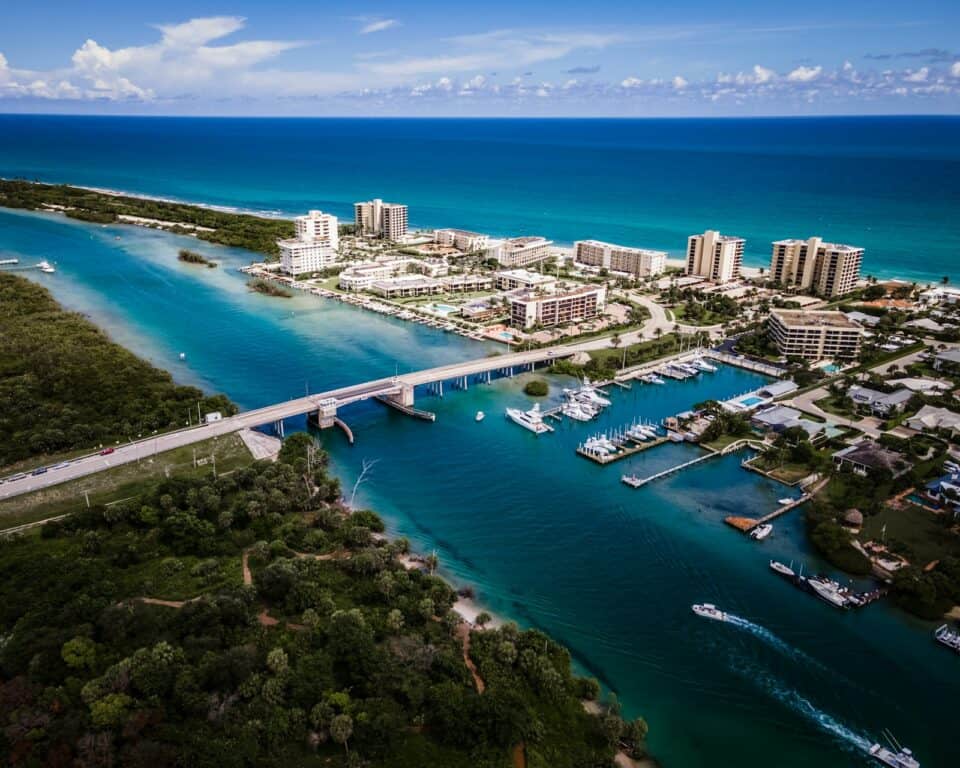
In a town that fronts the Lake Worth Lagoon, the flood question was never whether — it’s how much. Lake Park’s eastern blocks run down to the Intracoastal at Kelsey Park and the Lake Park Harbor Marina, about a mile north of the Lake Worth Inlet, and FEMA’s flood maps for Palm Beach County that took effect December 20, 2024 moved roughly 5,800 coastal parcels countywide into high-risk special flood hazard areas while raising base flood elevations on 16,000-plus more. But the map is not the whole story, because flooding is decided close to home: your home’s immediate surroundings, its elevation relative to the properties beside it, and how the ground drains — which is why heavy summer rain can pond water on blocks well west of the lagoon, far from any dock. Standard homeowners policies exclude flood (a few carriers offer optional flood endorsements — never automatic), so it’s a separate policy for every home.
“My lender doesn’t require it” is the bank reading a zone letter — not anyone assessing how water behaves on your street. Under FEMA’s Risk Rating 2.0 methodology, flood pricing is no longer driven by your zone: premiums are built from your distance to a flooding source, your home’s rebuild cost, and its elevation and first-floor height — so two Lake Park addresses a few blocks apart can price very differently, and the inland side of town often prices lower than owners expect. Annual increases on most existing NFIP policies are capped at 18% under the 2014 Homeowner Flood Insurance Affordability Act. And one clear signal of where Florida is headed: Citizens ties flood insurance to wind coverage — a statewide requirement phased in through January 1, 2027.
We quote both NFIP policies (up to $250,000 building / $100,000 contents) and private flood markets, which can offer higher limits where the NFIP caps out — a real consideration on lagoon-front and marina-district homes whose rebuild costs run past the federal ceiling. Five minutes with an agent settles the “how much” question for your specific address.
Umbrella insurance in Lake Park, FL
An umbrella policy is designed to sit above your home and auto liability limits — typically sold in $1 million increments — and add an extra layer when a serious claim or lawsuit exceeds what those underlying policies carry. It’s the coverage people research after a close call on US-1 or Northlake Boulevard; the better time is before.
The Lake Park case for an umbrella is concrete. Daily miles on I-95 and US-1 raise the stakes of any at-fault accident, and Florida’s share of uninsured drivers raises them further. Waterfront life adds exposures a dry lot doesn’t — guests on docks and boats, and boat liability itself is a policy conversation of its own. Pools are everywhere in this climate, and many owners of the town’s established homes hold just what liability claims target: built-up equity and retirement savings. An umbrella is designed to help protect those accumulated assets, subject to the policy’s terms and its required underlying limits.
Carriers require minimum liability limits on your home and auto policies before an umbrella attaches, so it’s usually quoted as part of a package review rather than alone — which is precisely the package review an independent agent runs in one pass across our carriers.
One Lake Park quote request. 20+ Florida homeowners carriers.
Cornerstone is an independent agency — we represent many carriers rather than one. For Lake Park homes we compare 20+ Florida homeowners carriers, and 25+ carriers across our personal lines for auto, flood, umbrella, and more. The market here has moved: Citizens’ Palm Beach County personal residential policy count fell from 83,597 at year-end 2024 to 33,733 at year-end 2025, and to 24,516 by May 31, 2026, per Citizens’ own county reports — private carriers taking those policies back. When the market moves like that, homes that had one option suddenly have many, and we re-shop; you keep one agency and one phone number: 813.920.8181.
Already insured? The fastest re-shop is sharing your current policies through Canopy Connect — about one minute, no documents to dig up — and we’ll come back with what the rest of the Florida market says about your house.