
Homeowners Insurance in Opa-locka, FL
Cornerstone Insurance is an independent Florida agency, and we compare 20+ Florida homeowners carriers for Opa-locka homes. Most of the city went up in the 1940s through the 1960s, and carriers price those concrete-block houses by building era and documented roof age — the paperwork on your roof can matter more than the year on the deed. And because flood is its own policy — or endorsement — everywhere in Florida, Opa-locka included, the question here is how much flood coverage, never whether.
No fee to shop. Independent Florida agency · FL license L061107. We compare, you choose.
What shapes homeowners insurance rates in Opa-locka
Ask what actually generates claims in our Florida book and the answer isn’t hurricanes — it’s water damage. A cast-iron drain line that finally rusts through, a supply hose behind the washer, a water heater that lets go on a Tuesday. In a city where the typical home dates to the 1960s, plumbing has had a long career, and it produces more claims than any storm season. We encourage clients to carry as much water-damage coverage as they can qualify for, because it isn’t a given: recent water losses, the age of the home, and the type and age of its plumbing can limit — or even exclude — water coverage with some carriers, while others price it generously and discount homes with automatic water shut-off valves or leak-detection devices. Fire sits at the opposite end of the curve: far less frequent, but the most severe loss a homeowner faces, which is why the rebuild limit deserves more attention than the premium. That spread between carriers is the whole reason we compare 20+ of them.
Wind exposure here starts with ordinary summers, not the tropics: convective thunderstorms push straight-line wind, hail, and lightning across northwest Miami-Dade every year, and they open more roofs than named storms do. The named-storm record is real history all the same — the September 1926 Great Miami hurricane ended the land boom that was building Opa-locka’s Moorish downtown, and Hurricane Andrew in 1992 showed the county’s south end what design-limit wind can do. That history is why Miami-Dade and Broward — and only those two counties — make up the Florida Building Code’s High-Velocity Hurricane Zone, with structures engineered around 175-mph three-second gusts and impact-rated products required on permitted work. For Opa-locka’s older block homes, a wind-mitigation inspection that documents roof shape, deck attachment, and strapping is often the single largest set of credits on the table.
Sinkholes deserve an honest local read: reported sinkhole activity in Miami-Dade is low — this is not the karst belt north of Tampa Bay. Every admitted Florida policy automatically includes catastrophic ground cover collapse, and the broader sinkhole-loss endorsement is a different, more complicated product we walk through in the FAQ below.
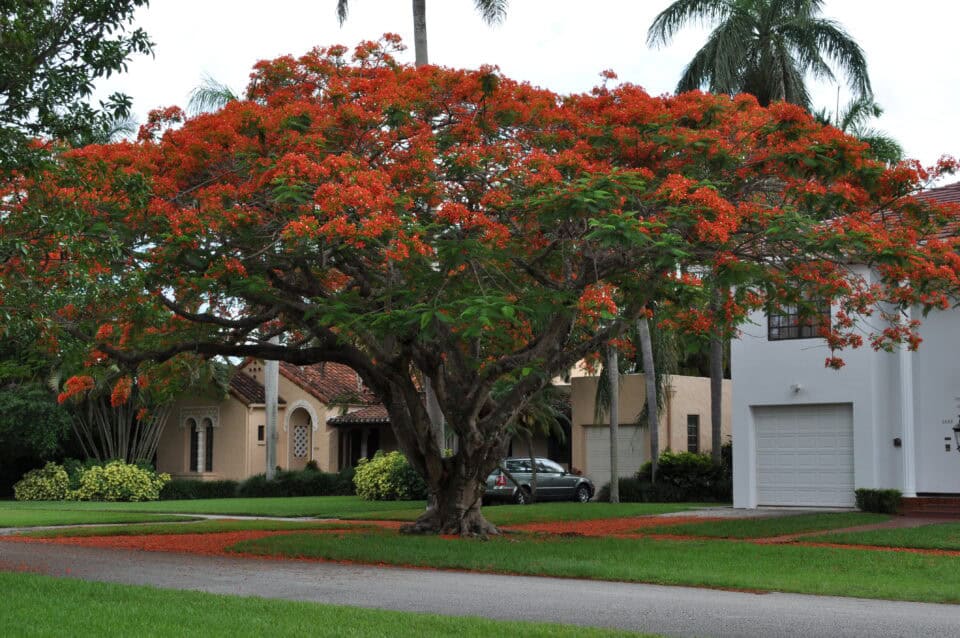
Carriers don’t price a home’s age on a straight line — they price building eras, matching construction type to that cohort’s claims record. Opa-locka’s cohorts are distinct: concrete-block homes from the 1940s through the 1960s dominate the city (the median build year is 1968), from the blocks around the historic Moorish downtown on Sharazad Boulevard — where twenty original buildings sit on the National Register of Historic Places — to Nile Gardens near the Golden Glades. West of downtown, some houses predate 1939 entirely. A well-kept 1950s-built block home with a documented young roof can outperform a fast-built 1980s frame home on the same quote, and documented roof age lives inside that driver: carriers price what the permit and inspection paperwork proves, not what the listing says. On every quote, carriers embed replacement-cost estimators to gauge the Coverage A rebuild limit rather than guessing — and in the HVHZ, a law & ordinance endorsement matters, because an older home that takes a major loss gets rebuilt to current code, not the code it was built under. For the county-wide carrier picture, see our Miami-Dade County home insurance guide.
Auto insurance in Opa-locka, FL
Opa-locka drives a dense urban grid: NW 27th Avenue and NW 135th Street carry the daily load, the Gratigny Parkway runs the city’s southern edge toward the Palmetto, and the Golden Glades interchange feeds I-95 just to the northeast. Unlike most of Florida, this is a genuinely transit-served city — Tri-Rail stops right on Ali Baba Avenue and several Metrobus routes cross town — yet most working households still keep cars on some of the metro’s heaviest traffic, and many keep more than one.
We recommend quoting from 100/300 liability limits — the level leasing companies typically require — as the minimum we recommend for comparison and contemplation, with higher limits where they fit. Add uninsured/underinsured motorist coverage on top: Florida consistently ranks among the states with the largest share of drivers carrying no coverage at all (Insurance Research Council), and heavy urban traffic multiplies your contact with them. When your liability need outgrows what an auto policy carries, an umbrella is the opportunity for another layer — more on that below. Bundling home and auto with one agency also unlocks same-agency discounts across our 25+ carriers across our personal lines.
Flood insurance in Opa-locka, FL
The framing we use everywhere in Florida fits Opa-locka better than most places: the question is how much flood coverage you need, never whether you need it. Standard homeowners policies exclude flood — a few carriers offer optional flood endorsements, never automatic — so flood protection is its own policy, or endorsement, for every address in the city.
Flooding is decided street by street: by a home’s immediate surroundings, its elevation relative to the houses and pavement beside it, and how fast the soil and drains can move water — it happens far from any coast. Opa-locka is flat and low-lying, the city’s own Stormwater Master Plan describes its canals, swales, storm sewers, and exfiltration systems as aged and under-sized in many places, and the blocks around NW 135th Street have gone underwater in heavy summer rain with no hurricane anywhere in sight. Distance from Biscayne Bay does keep storm surge largely off the table this far inland — during Hurricane Irma in 2017, the National Hurricane Center documented 3–5 feet of surge along the bay shoreline, not out here — but rain has never read a surge map.
FEMA prices NFIP policies under Risk Rating 2.0 by the factors that predict loss — distance to a flooding source, rebuild cost, and elevation including first-floor height — not by which lettered zone a map assigns. Parts of Opa-locka map to A, AE, and AH zones, but plenty of ponding happens outside them. Two useful specifics: the city participates in FEMA’s Community Rating System, which earns a discount on many NFIP policies written here, and most existing NFIP policies can’t increase more than 18% per year under the 2014 Homeowner Flood Insurance Affordability Act.
NFIP coverage tops out at $250,000 for the building and $100,000 for contents; private flood can go higher and is often competitive on these block homes. One more scheduling note if your wind coverage is with Citizens: Citizens ties flood insurance to wind coverage — a statewide requirement phased in through January 1, 2027.
Umbrella insurance in Opa-locka, FL
An umbrella policy is designed to add a layer of liability protection above your home and auto limits, typically sold in $1 million increments. The exposures in Opa-locka are everyday ones: long stop-and-go commutes on 27th Avenue and I-95, a steady share of uninsured drivers around you, pools and dogs, teen drivers, and — for the many owners who hold a rental house or duplex here — tenants and their guests. If a serious at-fault accident or an injury on your property could blow through your liability limits and into your savings or home equity, an umbrella is worth pricing; it usually costs less than people expect.
Umbrella carriers require minimum limits on the policies beneath them, and the common asks run higher than most households carry: 250/500 bodily injury or a $300,000 or $500,000 combined single limit on the auto, $300,000 of personal liability on the home, and similar limits on any watercraft or motorcycle, so the umbrella quote and the limits review belong in the same conversation. Like every policy, an umbrella responds subject to its own terms, so we’ll walk through what yours is designed to sit on top of.
One Opa-locka quote request. 20+ Florida homeowners carriers.
Miami-Dade’s homeowners market moves: private carriers assumed more than 546,000 Citizens policies statewide in 2025, and Citizens’ countywide personal-residential count stood near 70,000 policies in mid-2026. Churn like that is the argument for an independent agency: the carrier that priced your block and building era best last time may not be the one that prices it best now. We’re a Florida agency with a team serving all 67 counties, and one quote request puts your home in front of 20+ Florida homeowners carriers at once.
Want the fastest path? Share your current coverage securely in about a minute with Canopy Connect and we’ll re-shop it line by line — or start fresh below.