
Homeowners Insurance in Sanford, FL
Sanford is one of the few Central Florida cities with a true riverfront — downtown faces Lake Monroe, where the St. Johns River widens on its way north — and that geography sharpens one question about homeowners insurance in Sanford, FL: how much flood coverage to carry, never whether. Flood is its own policy — or endorsement — everywhere in Florida, Sanford included, and standard homeowners policies exclude it. We’re an independent Florida agency, and we compare 20+ Florida homeowners carriers to match your home — from a 1920s bungalow in the historic district to a 2020s build off Celery Avenue — with a carrier well matched to write it.
Free, no obligation — talk to a licensed Florida agent today.
Homeowners insurance in Sanford: what actually drives claims and rates
Ask what generates the most claims in Sanford and the answer, in our agency’s experience, isn’t a hurricane — it’s water from inside the house. A failed supply line, a water heater that lets go, a slow leak behind a bathroom wall. That’s true in the 2000s-built homes near Rinehart Road, and it’s doubly true in the Residential Historic District, where a 1920s home can still carry runs of original galvanized or cast-iron plumbing. Carriers handle interior water very differently: some will write full water-damage coverage on an older Sanford home, others cap it, and a few limit or even exclude it once the home’s age, the type and age of its plumbing, or recent water losses cross their thresholds. Our standing guidance is to carry as much water-damage coverage as your home can qualify for — and to ask about the discount many carriers offer for an automatic water shut-off or leak-detection device, which can pay for itself. Fire is the mirror image: far less frequent here, but the most severe losses we see, which is why the rebuild-cost limit matters more than any other number on the policy — and why carriers embed replacement-cost estimators on every quote to gauge that rebuild limit rather than guessing.
The wind claims Sanford homeowners actually file mostly come from ordinary summer afternoons, not named storms. Central Florida sits in some of the most lightning-prone territory in the country, and the convective thunderstorms that build over Seminole County all summer bring straight-line wind, hail, and lightning strikes — claims that typically fall under your standard deductible. Named storms are the second chapter. Hurricane Ian crossed Central Florida in September 2022 and Hurricane Milton followed in October 2024, dropping 10–15+ inches of rain on Seminole County; hurricane wind claims carry a separate percentage-based hurricane deductible, typically 2% of your dwelling limit. If your home has never had a wind-mitigation inspection, that one report — documenting roof shape, deck attachment, and roof-to-wall connections — is often the single largest discount available on a Sanford homeowners policy. The rain side of those same storms is its own conversation — see flood below.
Sanford sits on the same karst limestone as the rest of Central Florida, but Seminole County sits at the edge of Florida’s sinkhole story, not its center: in the state insurance regulator’s review of 2006–2010 sinkhole claims, about two-thirds came from Hernando, Pasco, and Hillsborough counties — not here. Every admitted Florida policy automatically includes catastrophic ground cover collapse; full sinkhole loss coverage is a separate, more complicated question we walk through honestly in the FAQ below.
Housing stock is where Sanford gets genuinely interesting to underwrite, because the city spans a full century of construction and carriers price building eras as cohorts, not on a straight age line. They look at how a cohort was built and how that cohort has actually performed in claims — which is why a solidly built early-1900s home in Sanford Heights, Georgetown, or San Lanta can sometimes out-quote a fast-built 1980s frame home, and why 1980s-built communities like Mayfair Villas and Mayfair Meadows quote differently from the mid-2000s homes in Preserve at Lake Monroe off 17-92, the gated 1990s–2000s sections of Lake Forest on the SR 46 corridor, or the 2020s-built homes in Wilson Park, Woodsong, and Terracina at Lake Forest. Documented roof age lives inside that same driver: carriers price the roof they can see paperwork for, so a permit or roofer’s letter for a 1980s-built home’s newer roof directly changes the quote. East of town along Celery Avenue toward the rural boundary, larger lots add their own wrinkles — wells, fences, and outbuildings that need to be listed on the policy rather than assumed. For the county-wide picture, including how we rank carriers for this market, see our guide to the best home insurance companies in Seminole County.
Auto insurance in Sanford, FL
Sanford commutes. The city has more transit than most Florida towns its size — a SunRail station with a free trolley into downtown, plus LYNX routes along a few corridors like 17-92 — but that service is concentrated where the corridors run, and for most households it doesn’t replace a car. Practically every working adult here drives, so households run two or three vehicles, and the driveway often holds a boat trailer bound for the Lake Monroe ramps on top of that. The daily reality is I-4, SR 417, and 17-92 into Lake Mary and Orlando, plus the traffic that Orlando Sanford International Airport pulls through the east side of town — high-speed, high-volume roads where the other driver may be carrying Florida’s minimum limits or nothing at all.
That’s why, when we quote auto in Sanford, we recommend at least 100/300 bodily-injury liability — the level leasing companies typically require — and recommend going higher where it fits the household. We also recommend adding uninsured/underinsured motorist coverage, which is designed to help protect your own family when the at-fault driver can’t; on I-4, that scenario is not rare. Insuring home and auto through the same agency can unlock a bundle discount on both sides, and for teen drivers — and Sanford has plenty — good-student and telematics discounts can take real money off the bill. If your assets or your drivers outgrow even 100/300, that’s the opening for an umbrella policy, covered below.
Flood insurance in Sanford, FL
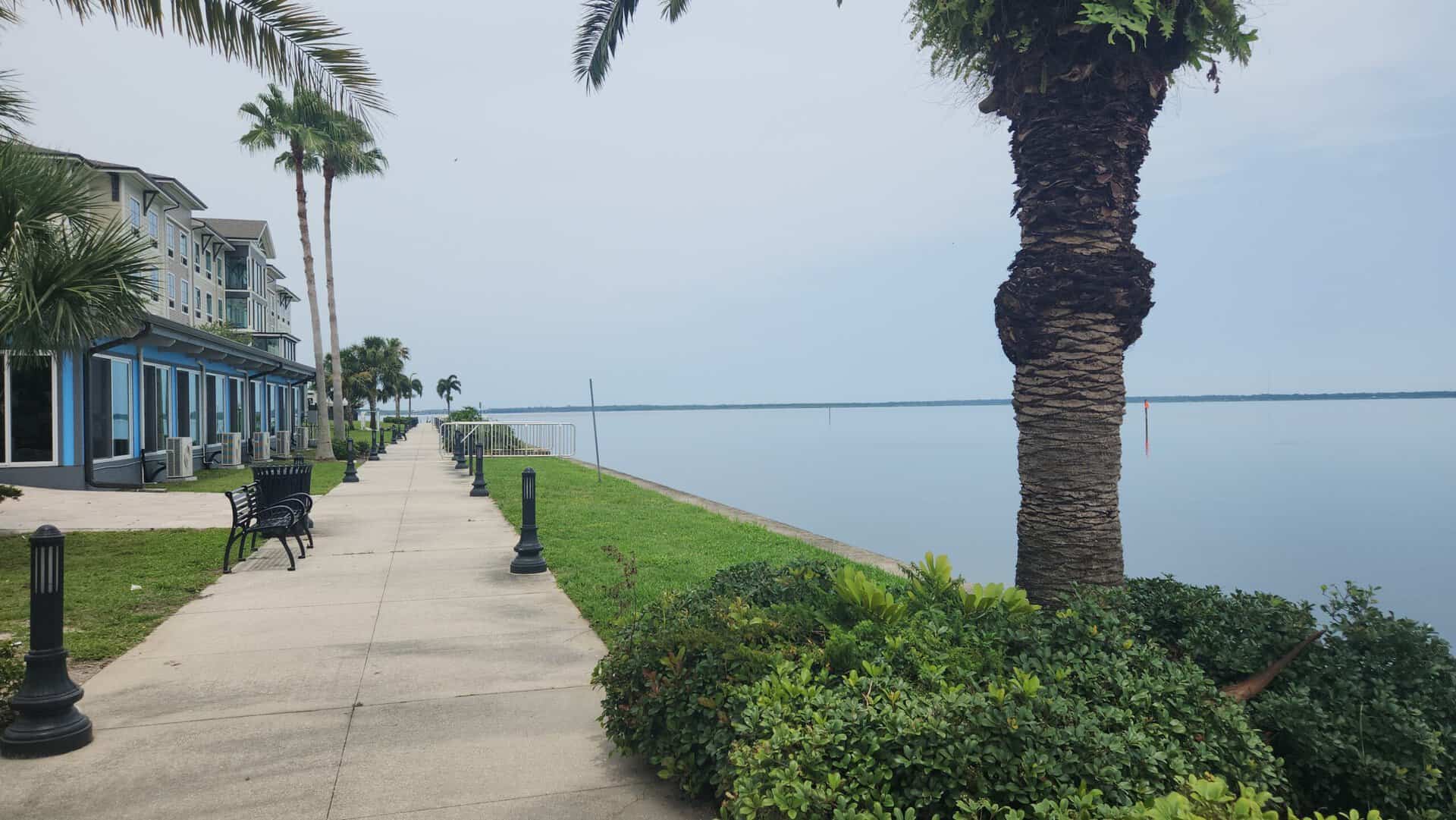
Sanford’s flood story is written into the record books. In October 2022, after Hurricane Ian, the St. Johns River at Sanford crested at 8.96 feet — above the 8.59-foot record that had stood since 1953. Lake Monroe topped the downtown seawall, water crossed Seminole Boulevard into lakefront parks and parking lots, and portions of the lakefront road stayed closed for roughly two months. Two years later, Hurricane Milton’s 10–15+ inches of rain had the river back at moderate flood stage more than a week after landfall. Sanford is fully inland — storm surge is not part of this picture — but river and rainfall flooding very much are.
Here’s the part that surprises people: the flood map of Sanford is not just the lakefront. Whether a particular home floods is decided by its immediate surroundings — how it sits relative to the streets and houses around it, where the runoff has to go, and how the local soil drains — which is why flood claims turn up in neighborhoods nowhere near the river. So the question we ask isn’t whether a Sanford homeowner needs flood coverage. Everyone in Florida needs some. The question is how much. Standard homeowners policies exclude flood — a few carriers offer optional flood endorsements, but never automatically — so it takes a deliberate decision: an NFIP policy (up to $250,000 building / $100,000 contents), a private flood policy where higher limits make sense, or an endorsement where a carrier offers one.
Under FEMA’s Risk Rating 2.0, flood premiums aren’t set by which zone letter your home falls in — they’re driven by the home’s distance to a flooding source, its rebuild cost, and its elevation and first-floor height. That’s why two Sanford homes a street apart can price very differently, and it’s worth knowing that most existing NFIP policies can’t increase more than 18% per year under federal law. Unincorporated Seminole County has earned a Class 6 Community Rating System score, which translates to a 20% NFIP discount in mapped high-risk zones; what applies inside Sanford city limits depends on the city’s own CRS participation, and we check that for your specific address. One more scheduling note: Citizens ties flood insurance to wind coverage — a statewide requirement phased in through January 1, 2027.
Umbrella insurance in Sanford, FL
An umbrella policy is designed to add a layer of liability protection — typically $1 million or more — above the limits on your home and auto policies. In Sanford the exposures that make it worth a conversation are ordinary ones: a backyard pool, a dog, a teen driver merging onto I-4, a boat on Lake Monroe or the St. Johns, a rental bungalow in the historic district. Any one of those can produce a claim that runs past a home or auto liability limit, and the umbrella is built to pick up where those policies stop, subject to its own terms.
Umbrellas generally cost less than people expect, because they sit above your other coverage rather than replacing it. Umbrella carriers set their own minimum limits on the policies underneath, and most ask for more than the auto floor we recommend: commonly 250/500 bodily injury or a $300,000 or $500,000 combined single limit on the auto, $300,000 of personal liability on the home, and similar limits on any boat or motorcycle policy, so we quote the umbrella and the underlying policies together. We quote it as part of the same conversation, not as an upsell.
20+ Florida homeowners carriers, shopped for you
Seminole County has seen how fast this market can move: Citizens — the state-backed insurer of last resort — saw its personal residential multiperil policy count in the county fall from 18,963 on May 31, 2024 to 1,241 on May 31, 2026, as private carriers took that business back. Movement like that is why an independent agency earns its keep. We quote your Sanford home across 20+ Florida homeowners carriers — 25+ carriers across our personal lines — match the ones whose appetite fits your home’s era, roof, and claims history, and re-shop it when the market moves again.
Already insured? Share your current coverage in about a minute through Canopy Connect — no forms, no digging through paperwork — and we’ll line up your existing policy against the market.