
Homeowners Insurance in Sewall’s Point, FL
Sewall’s Point is a peninsula — the St. Lucie River on one side, the Indian River Lagoon on the other — so nearly every home in town lives close to open water, and the useful question is how much flood coverage to carry, never whether to carry it. Flood is its own policy — or endorsement — everywhere in Florida, Sewall’s Point included. Cornerstone is an independent Florida agency: one quote request puts your home in front of 20+ Florida homeowners carriers, and we can round out auto, flood, and umbrella in the same conversation.
Free, no obligation — talk to a licensed Florida agent today.
What shapes homeowners insurance rates in Sewall’s Point
Start with the claim that actually shows up: water damage. Across the homes we insure, the losses we handle most often aren’t hurricane stories — they’re a supply line letting go behind a wall, a water heater failing on a slab, an appliance hose splitting while nobody’s home. In a town where the median house dates to the late 1970s, the age and type of plumbing matter as much as the address. We encourage clients to carry as much water-damage coverage as they can qualify for, because carriers don’t treat it uniformly — recent water losses, the home’s age, and original-era supply lines can limit or even exclude water coverage with some of our markets, while others can write it in full, especially with an automatic water shut-off or leak-detection device, which several carriers also discount. Fire sits at the other end of the spectrum: far less frequent, but the most severe loss a home can take, which is why we check the rebuild-cost limit on every quote instead of guessing.
Wind here is mostly not the wind you’re picturing. The everyday version is the summer thunderstorm season — convective storms carrying lightning, straight-line gusts, and the occasional hail core. Named storms are the second chapter, and Sewall’s Point has real history in it: Hurricane Frances came ashore at the southern end of Hutchinson Island as a Category 2 on September 5, 2004 — a barometric low of 962 mb was measured at Sewall’s Point itself — and three weeks later Hurricane Jeanne made landfall at virtually the same spot with winds near 120 mph. That history is why wind-mitigation credits are worth documenting: opening protection, roof shape, and roof-to-wall attachments recorded on the OIR-B1-1802 inspection form (generally valid for five years) can meaningfully move the wind portion of a premium.
Sinkholes are a question we get, so here’s the honest local answer: reported activity in this part of the coast is low. A WPTV analysis of state-tracked sinkhole and subsidence incidents found just 16 of roughly 27,000 statewide came from the five-county region that includes Martin — among the least sinkhole-prone areas in Florida. Every admitted Florida policy automatically includes catastrophic ground cover collapse coverage under s. 627.706, Florida Statutes; the broader optional sinkhole endorsement is a separate, gated product we cover in the FAQ below.
The housing stock itself does a lot of the pricing. Carriers price building eras in cohorts — by construction type and that cohort’s claims record — not on a straight line, so a solid 1960s concrete-block ranch along the town’s wooded ridge can quote better than a fast-built frame home from a later decade. The Archipelago and Isle Addition, the island neighborhoods bulkheaded and filled in the 1960s, carry that era’s construction; High Point at the southern tip and Indialucie mix mid-century originals with substantial rebuilds; and the newer and remodeled homes off Sewall’s Point Road bring current-code construction to the table. Documented roof age lives inside that same driver — carriers price the roof they can verify, so a wind-mitigation report and a permit trail on 1970s-built homes often pay for themselves. For how our carriers stack up across the county, see our Martin County home insurance carrier guide.
Auto insurance in Sewall’s Point, FL
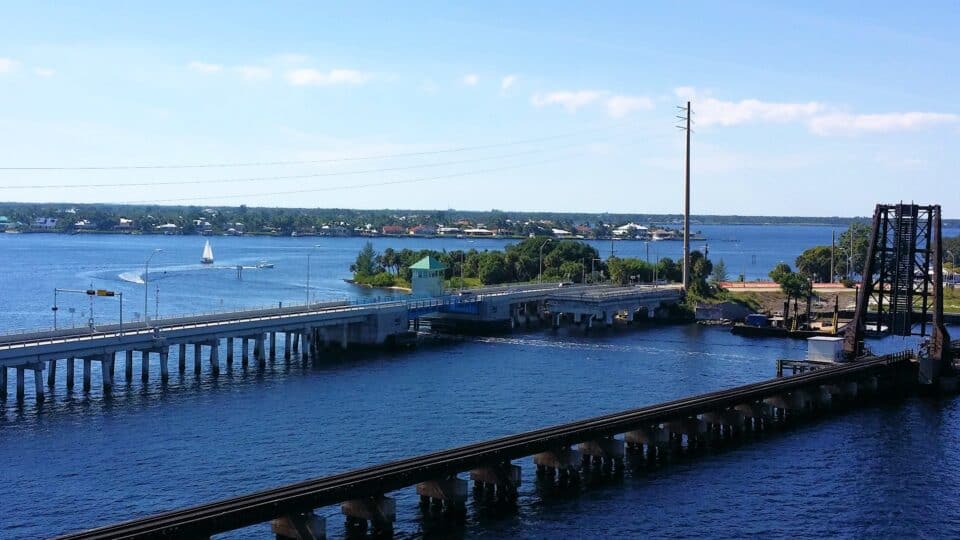
One road runs the length of town — Sewall’s Point Road, which carries State Road A1A up the spine of the peninsula — and everything in or out crosses a bridge: the Evans Crary Bridge to Stuart on one end, the Ernest Lyons Bridge to Hutchinson Island on the other. That routing means beach traffic funnels through town all season, and it means daily life is a driving life. Martin County’s MARTY buses run a handful of free fixed routes on the mainland, but service is sparse and doesn’t make the peninsula practical without a car — so households here typically run a vehicle per adult, often with a boat trailer behind one of them and a teenager crossing the bridge to school in Stuart.
For liability limits, we recommend at least 100/300 in liability limits — the level leasing companies typically require — with higher limits where they fit your picture, and uninsured/underinsured motorist coverage added, because the driver who hits you on A1A gets no say in your limits. From there, an umbrella policy is the opportunity for a much larger layer of protection over both cars and home — more on that below. Insuring home and auto through the same agency can also unlock same-agency bundle discounts with several of our carriers.
Flood insurance in Sewall’s Point, FL
Flooding is decided lot by lot: a home’s immediate surroundings, how it sits relative to the properties next to it, and how the ground drains. Sewall’s Point shows that in miniature — the wooded ridge along the peninsula’s spine sits noticeably higher, while some lower streets on the lagoon side have taken water, as they did when Hurricane Nicole pushed surge onto the east side of town in November 2022. Standard homeowners policies exclude flood (a few carriers offer optional flood endorsements — never automatic), which is why our advice townwide is about how much flood coverage to carry, never whether.
Under FEMA’s Risk Rating 2.0, NFIP premiums are driven by the property itself — distance to the flooding source, rebuild cost, and elevation and first-floor height — not by which mapped zone the lot falls in, and most existing NFIP policies are protected by an 18% annual increase cap from the 2014 Homeowner Flood Insurance Affordability Act. NFIP coverage tops out at $250,000 on the building and $100,000 on contents; plenty of Sewall’s Point homes would rebuild well above that, which is where private flood markets earn their place — higher limits, and sometimes better pricing on elevated or ridge-top homes. One more scheduling note for anyone considering Citizens: Citizens ties flood insurance to wind coverage — a statewide requirement phased in through January 1, 2027.
Umbrella insurance in Sewall’s Point, FL
An umbrella policy sits above the liability limits on your home and auto policies and is designed to add another layer — typically starting at $1 million — when a covered claim runs past the limits those policies carry. The Sewall’s Point profile makes the case on its own: pools, docks and boat lifts with guests on them, boats under tow on A1A, teen drivers, and households with real assets to protect. If a serious at-fault accident or an injury on your property produced a judgment, an umbrella is designed to stand between that judgment and what you’ve built, subject to its terms.
Umbrella carriers set their own minimum limits on the policies underneath, and most ask for more than the auto floor we recommend: commonly 250/500 bodily injury or a $300,000 or $500,000 combined single limit on the auto, $300,000 of personal liability on the home, and similar limits on any boat or motorcycle policy, so we quote the umbrella and the underlying policies together. We quote it alongside home and auto so the pieces are designed to fit together, subject to each policy’s terms.
One Sewall’s Point quote request. 20+ Florida homeowners carriers.
We’re an independent Florida agency — a team of licensed agents serving all 67 counties — which means we represent many carriers rather than one. One quote request puts your Sewall’s Point home in front of 20+ Florida homeowners carriers, and 25+ carriers across our personal lines for auto, flood, and umbrella. Citizens’ personal-residential multiperil policy count in Martin County fell from 8,770 policies in March 2024 to 1,543 by May 2026 — roughly an 82% decline, with those homes moving to private carriers — and an independent agency is how you shop that private market in one pass.
The fastest way to start: share your current policies through Canopy Connect — takes about a minute, no documents to dig up — and we’ll re-shop them across our markets and tell you straight whether staying put or moving is the better call.