
Homeowners Insurance in St. Marks, FL
Cornerstone Insurance is an independent Florida agency that compares 20+ homeowners carriers across the state, St. Marks included. This town sits where the Wakulla and St. Marks rivers come together, a few miles up from Apalachee Bay — which is why every policy review here starts with the water question: wind and homeowners on one policy, and flood as its own policy — or endorsement — everywhere in Florida, St. Marks included. We quote those carriers side by side, compare what each is designed to help with, and give you a straight recommendation.
Free, no obligation — talk to a licensed Florida agent.
What shapes homeowners insurance rates in St. Marks
Storms get the headlines in a river town, but the claim we handle most often in Wakulla County has nothing to do with weather: it’s water from inside the house — a supply line that lets go, a water heater that fails, a washing-machine hose that gives out while nobody’s home. That’s why we encourage every client to carry as much water-damage coverage as they can qualify for. Qualify is the operative word: recent water losses, the age of the home, and the type and age of its plumbing can limit — or even exclude — water coverage with some carriers, and each of our 20+ carriers draws those lines in a different place. An automatic shut-off valve or leak-detection system can earn a premium credit with many of them and, more importantly, can stop the loss before the floors are ruined. Fire claims are far rarer here, but they’re the most severe loss a household faces — which is why we check the rebuild limit on every quote instead of assuming the number on the old policy still holds.
On the wind side, the routine damage in St. Marks comes from ordinary summer thunderstorms rolling in off the Gulf — lightning strikes, gusts that peel shingles, and limbs down on rooflines. Named storms are the second conversation, and this town has real history to point to: Hurricane Helene came ashore in the Big Bend on September 26, 2024 as a Category 4 storm, and a USGS sensor at nearby Shell Point recorded water 6.53 feet above the normal high-tide line, with high-water marks of two to three feet above ground in parts of St. Marks. Your homeowners policy is designed to help with wind damage subject to its terms, usually behind a separate hurricane deductible calculated as a percentage of your dwelling limit — and a wind-mitigation inspection documenting roof shape, attachments, and opening protection is still one of the most reliable ways to bring the wind portion of the premium down.
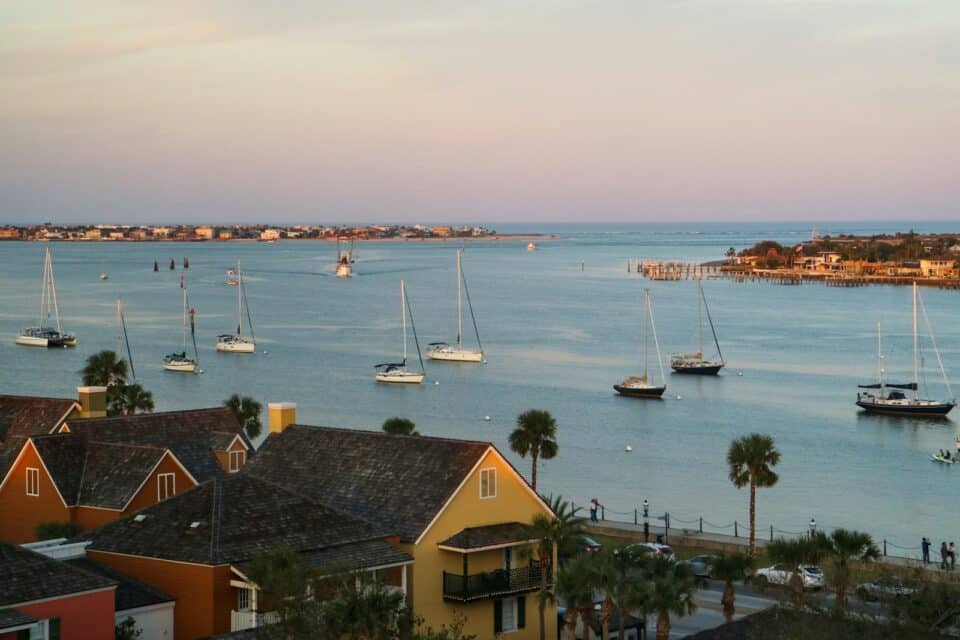
The lesson locals already know — and newcomers learn fast — is that in St. Marks the water, not the wind, is usually the defining peril. Hurricane Dennis proved it in July 2005: the storm made landfall roughly 170 miles west near Pensacola, yet the National Hurricane Center recorded six to nine feet of surge above normal tides in Apalachee Bay, inundating parts of town after a shelf wave and high tide stacked on top of the wind-driven water. Standard homeowners policies exclude rising water; that entire category of loss belongs to flood coverage, which is why the flood section below is not optional reading here. And the fine-grained truth applies even in a surge town: what floods on any given street is decided by the home’s immediate surroundings — its elevation relative to the lots around it, how the ground drains, and how close it sits to the rivers — not by a line on a map.
One peril that gets outsized attention and deserves calibration: sinkholes. St. Marks sits at the seaward edge of the Woodville Karst Plain, the limestone country that produces the springs and sinks upstream toward Wakulla Springs — but reported sinkhole-claim volume in Wakulla County has never approached what Tampa Bay’s counties have generated, and it is not one of the things moving your premium. Every admitted Florida policy automatically includes catastrophic ground cover collapse coverage; the fuller story lives in the FAQ below.
The housing stock itself is small — a couple hundred homes; most of the county’s newer construction went up around Crawfordville while the coastal towns stayed small and older-built. Some of that older stock is mobile homes, which our Florida mobile home insurance explainer treats as the separate market it is. What we quote in St. Marks is a mix: older cottages and fish-camp-era houses near the river, manufactured homes (Wakulla’s share runs well above the statewide norm), and newer elevated construction built with the flood maps in mind. Carriers price all of it in era cohorts — the construction type and claims record of each building generation, not a straight line by age — so a solid mid-century block home can quote better than a fast-built later frame home, and documented roof age is priced inside that same driver. Every quote also runs through the carrier’s replacement-cost estimator to set the Coverage A rebuild limit rather than guessing. For the county-wide picture, see our Wakulla County home insurance guide.
Auto insurance in St. Marks, FL
There’s no fixed-route bus service anywhere in Wakulla County — the county runs only a demand-response service for riders who qualify as transportation-disadvantaged — so in St. Marks every working adult drives, and most households run more than one vehicle: the commuter car heading up SR 363 toward Tallahassee, the truck that tows the boat to the ramp, sometimes a teen driver learning on the same two-lane road. Multi-vehicle and home-plus-auto bundling discounts do real work on a household budget like that, and quoting home and auto together is usually where we find the most savings.
On limits, our standing recommendation is at least 100/300 bodily-injury liability — the level leasing companies typically require — going higher where it fits the household. Florida’s minimums are nowhere near what a serious at-fault accident actually costs. We also recommend adding uninsured/underinsured motorist (UM/UIM) coverage, because a meaningful share of Florida drivers carry little or no bodily-injury coverage at all, and UM/UIM is what’s designed to help protect your own family in that scenario. When liability limits are set right, an umbrella policy becomes the natural next layer — more on that below.
One quote request prices your vehicles across our auto carriers alongside your home — and if there’s a boat on a trailer in the yard, which in St. Marks there often is, mention it, so the liability conversation accounts for the whole household.
Flood insurance in St. Marks, FL
In most Florida towns we open this section by explaining that flood insurance isn’t optional thinking. In St. Marks, history has already made the argument: Dennis in 2005 put Gulf water in the streets from a storm that came ashore near Pensacola, and Helene in 2024 flooded the marina district again. So the only real question here is how much flood coverage to carry — never whether. Standard homeowners policies exclude flood entirely; a few carriers offer optional flood endorsements, but coverage for rising water is never automatic, so it has to be placed deliberately on every single policy.
What you’ll pay is more individual than most people expect. Under the NFIP’s Risk Rating 2.0 pricing, the premium is driven by your specific home — its distance to the flooding source (and here that’s the rivers and the bay), its rebuild cost, and its elevation and first-floor height — not by which mapped zone it happens to sit in. That’s why the elevated homes in town, built with living space well above grade, can rate very differently from an older slab or a manufactured home a street away. For most existing NFIP policies, federal law caps annual increases at 18%, so a policy you keep in force glides toward its full rate rather than jumping.
The NFIP tops out at $250,000 for the building and $100,000 for contents. For homes that need more than that — or where a private carrier prices better — we also quote the private flood market, and we run both side by side rather than assuming one. Bring us a St. Marks address and we’ll price it as the individual property it is.
Umbrella insurance in St. Marks, FL
An umbrella policy adds a layer of liability protection — typically a million dollars or more — above the liability limits on your home and auto policies. In a town organized around the water, the exposures are easy to name: guests on a dock or a boat, a dog that doesn’t love strangers, a teen driver on the highway to Tallahassee, a golf cart on a quiet street. One serious liability claim can reach past standard policy limits, and the umbrella is what’s designed to help when it does, subject to its own terms.
Umbrellas require underlying home and auto liability at set minimums — another reason we recommend getting those limits right first — and they typically cost less than people assume for the amount of protection involved. We can add an umbrella review to any home or auto quote; it takes minutes.
One St. Marks quote request. 20+ Florida homeowners carriers.
As an independent Florida agency, we represent many carriers rather than one. One quote request puts your St. Marks home in front of 20+ Florida homeowners carriers — 25+ carriers across our personal lines — and we come back with the options that actually fit a river-town property, explained in plain terms. The private market’s appetite here is a matter of record: Citizens’ personal residential policy count in Wakulla County fell from 518 at the end of 2024 to 210 by mid-2026 — hundreds of local homes placed back with regular carriers.
Already insured? The fastest re-shop is sharing your current policies through Canopy Connect — a few clicks, no paperwork, and we review what you have against the whole market, including discounts your current policy may be missing.