
Homeowners Insurance in Sweetwater, FL
Cornerstone Insurance is an independent Florida agency — one quote request here goes out to 20+ Florida homeowners carriers, and a licensed agent walks you through what comes back. Sweetwater sits on flat ground along the Tamiami (C-4) Canal, which makes flood coverage a how-much decision rather than a whether decision — and flood is its own policy, or an optional endorsement with a few carriers, everywhere in Florida, Sweetwater included. We price it alongside the home so you see the whole picture at once.
Free, no obligation — talk to a licensed Florida agent today.
What shapes homeowners insurance rates in Sweetwater
Start with the claims we actually handle, because most of them have nothing to do with hurricanes. Across our Florida book, the loss we see most often in a city like Sweetwater is water damage from inside the house — a supply line letting go behind a wall, a water heater rusting out, an A/C condensate line backing up while everyone is at work. Much of Sweetwater’s housing went up during the city’s big 1970s growth run, and plumbing and appliances from that era are at the age where they fail. Water is also where Florida carriers disagree with each other the most: some quote generous water-damage coverage, others attach a limited-water endorsement, and a home’s recent water losses, its age, and the type and age of its plumbing can shrink — or even exclude — water coverage with certain carriers. Our standing advice is to carry as much water-damage coverage as you can qualify for, and to ask about automatic water shut-off and leak-detection devices, which several carriers reward with a discount. Fire sits at the other end of the spectrum: far less frequent, but the most severe loss a homeowner can face, which is why the rebuild-cost limit on the policy matters more than any single discount.
Wind is the risk every Sweetwater policy has to answer for, and most years it shows up as ordinary summer thunderstorms — straight-line gusts, hail, lightning — not as a named storm. Hurricanes are the reason the building code here is what it is: after Hurricane Andrew in 1992, Miami-Dade and Broward became Florida’s High-Velocity Hurricane Zone, the only two counties in it, with standard structures in Miami-Dade engineered to 175-mph three-second gusts and roofing products required to carry Miami-Dade approval. For your premium, that code strength is leverage. A wind-mitigation inspection documents the features a home already has — roof shape, deck attachment, roof-to-wall connectors, opening protection — and those credits are among the largest discounts available on a Florida homeowners policy. Sweetwater sits well inland from Biscayne Bay, so storm surge isn’t the local water story; rainfall and the canal are, and that’s the flood section below.
One risk worth keeping in perspective: sinkholes. Limestone underlies all of South Florida, but reported sinkhole activity in Miami-Dade County is minimal — this is not the Tampa Bay karst belt. Every admitted Florida homeowners policy automatically includes catastrophic ground cover collapse coverage under s. 627.706, Florida Statutes, and carriers must offer a broader sinkhole-loss endorsement for additional premium, though approval is never guaranteed. In Sweetwater that endorsement is rarely the deciding factor on a quote — the FAQ below covers how it actually works, and we’ll tell you straight what is and isn’t realistic to place.
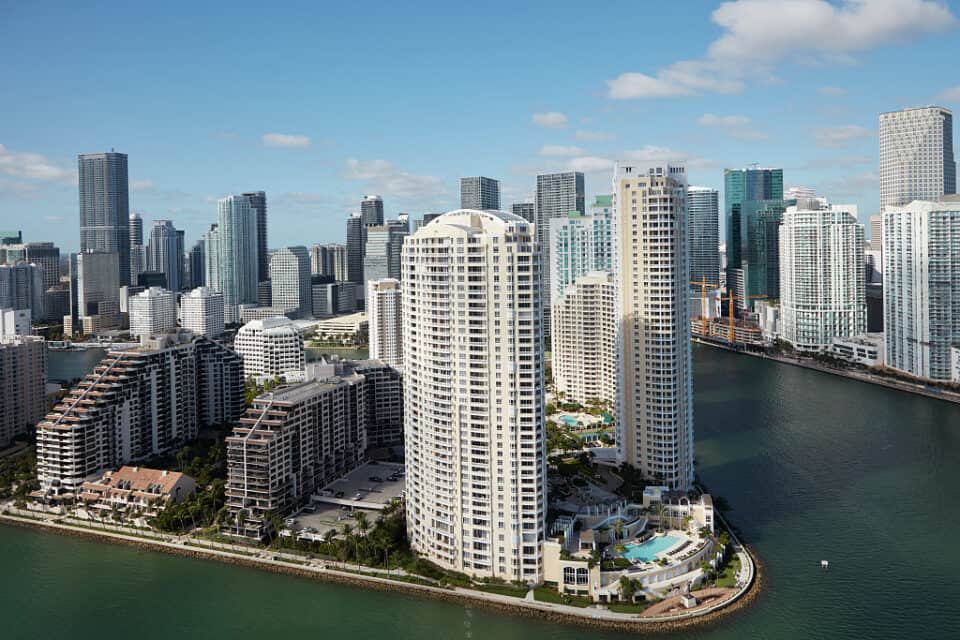
Sweetwater incorporated in 1941 and was still a village of fewer than two hundred homes at the end of the 1950s. Most of the city dates to the 1970s, when it grew faster than any other municipality in Dade County — FIU had just opened across SW 8th Street and the Dolphin Expressway went in — so the residential core is a compact grid between W Flagler Street and SW 8th Street, roughly SW 107th Avenue over to the Turnpike, dominated by one-story concrete-block homes and duplexes from the 1960s through the 1980s. The land annexed north of SR 836 around Dolphin Mall after the 2010 vote is largely commercial, and the east edge near FIU has added modern mid- and high-rise housing. Carriers don’t price a home’s age on a straight line: they price building-era cohorts by construction type and that cohort’s claims record, so a well-kept 1970s-built concrete-block house with a documented newer roof can quote better than its age suggests. Documented is the key word — keep roof permits and inspection paperwork, because carriers price documented roof age, and in the HVHZ that paperwork does double duty. If you own a duplex or rent out a unit, mention it; that’s a landlord (DP-3) policy conversation, and we write those too. For a carrier-by-carrier view of the wider market, see our guide to the best home insurance companies in Miami-Dade County.
Auto insurance in Sweetwater, FL
Sweetwater driving is dense-urban driving. The city is boxed in by W Flagler Street, SW 8th Street, SW 107th Avenue, and the Turnpike, with SR 836 running across its north side — and FIU’s campus next door adds tens of thousands of commuting students and staff to those same corridors. Stop-and-go miles are where fender-benders happen, and the injury claims that follow are why we recommend at least 100/300 in liability limits — the level leasing companies typically require — with higher limits where they fit your situation. We also recommend adding uninsured/underinsured motorist (UM/UIM) coverage on top of those limits, because a meaningful share of the drivers around you carry little or no bodily-injury coverage at all, and UM is designed to protect your household when one of them causes the crash. For larger cushions still, an umbrella policy adds a layer over both home and auto — more on that below.
Unlike much of Florida, Sweetwater has genuinely usable transit — limited-stop Metrobus service runs the Flagler corridor to downtown, and express buses leave the Dolphin Station park-and-ride on SR 836 — but most households here still run a vehicle for every working adult, and many run more than one. Insuring the home and the cars through the same agency usually earns a bundle discount with several of our carriers, and because we quote 25+ carriers across our personal lines from one request, you see the bundled and unbundled numbers side by side instead of taking one company’s word for it.
Flood insurance in Sweetwater, FL
Sweetwater’s defining insurance fact is water on the ground. The city sits on flat, low-lying land at the edge of the Everglades basin, and its drainage runs through the Tamiami (C-4) Canal along the north side of town. In October 2000, a no-name storm flooded more than 90,000 homes across Miami-Dade, with Sweetwater among the hardest-hit areas — a year after Hurricane Irene had already put its streets under water. The South Florida Water Management District answered with the C-4 Flood Protection Project: a 900-acre emergency detention basin west of the city that can hold roughly a billion gallons, forward pump stations, and floodwalls and berms along the canal through Sweetwater itself. That infrastructure changed the odds; it didn’t repeal them. Flooding here is decided house by house — by a lot’s elevation relative to the streets and homes immediately around it, how those few blocks drain and how quickly the ground under them absorbs, and how much rain falls in how few hours. Standard homeowners policies exclude flood damage entirely; a few carriers offer optional flood endorsements, but it’s never automatic.
So the Sweetwater question is how much flood coverage, not whether. Under FEMA’s Risk Rating 2.0, flood premiums are priced on your home’s distance to the flooding source — here, the canal — its rebuild cost, and its elevation and first-floor height, not simply on which mapped zone it sits in, and federal law caps annual increases on most existing NFIP policies at 18%. The NFIP writes up to $250,000 on the building and $100,000 on contents, and private flood carriers can go higher or broaden the coverage where that makes sense. One schedule worth knowing: Citizens ties flood insurance to wind coverage — a statewide requirement phased in through January 1, 2027. We price flood alongside every Sweetwater home quote so you decide from a real number instead of a guess.
Umbrella insurance in Sweetwater, FL
An umbrella policy is a layer of liability coverage that sits above your home and auto policies, usually sold in $1 million increments. When a serious claim exhausts the liability limit underneath it — a bad crash, a guest badly hurt on your property — the umbrella is designed to continue where those limits stop, subject to the policy’s terms. It’s the difference between a hard year and a judgment that follows your income and savings for years.
Sweetwater households tend to have more liability exposure than they think. Every working adult driving those dense Flagler and 107th Avenue corridors is exposure. A teen driver on the policy is exposure. So are a pool in the backyard, a dog, and — common in this city’s duplex-heavy housing stock — a rental unit with tenants coming and going. None of that makes anyone a bad risk; it just means the liability math deserves a real look rather than a shrug.
Umbrella carriers require minimum liability limits on the home and auto policies underneath, so this is a package conversation: we line up the underlying limits and the umbrella together, across multiple carriers, and show you what the whole structure costs. Many clients find the added layer costs less than they expected — but the number that matters is the one quoted for your household.
One Sweetwater quote request. 20+ Florida homeowners carriers.
Miami-Dade has long been Citizens Property Insurance’s largest county, and its market has moved dramatically: between the end of 2024 and May 2026, Citizens’ policy count in the county fell from about 168,000 to just under 70,000 as private carriers took on policies through depopulation. Movement on that scale means the carrier that priced your home best two renewals ago may not be the one that prices it best at your next renewal — which is exactly the problem an independent agency exists to solve. One request here, and a licensed Florida agent compares 20+ homeowners carriers, explains the differences that matter, and stays your single point of contact after you bind.
Already insured and short on time? Share your current policies securely through Canopy Connect — it takes about a minute, and we re-shop what you have against the market.