
Homeowners Insurance in Welaka, FL
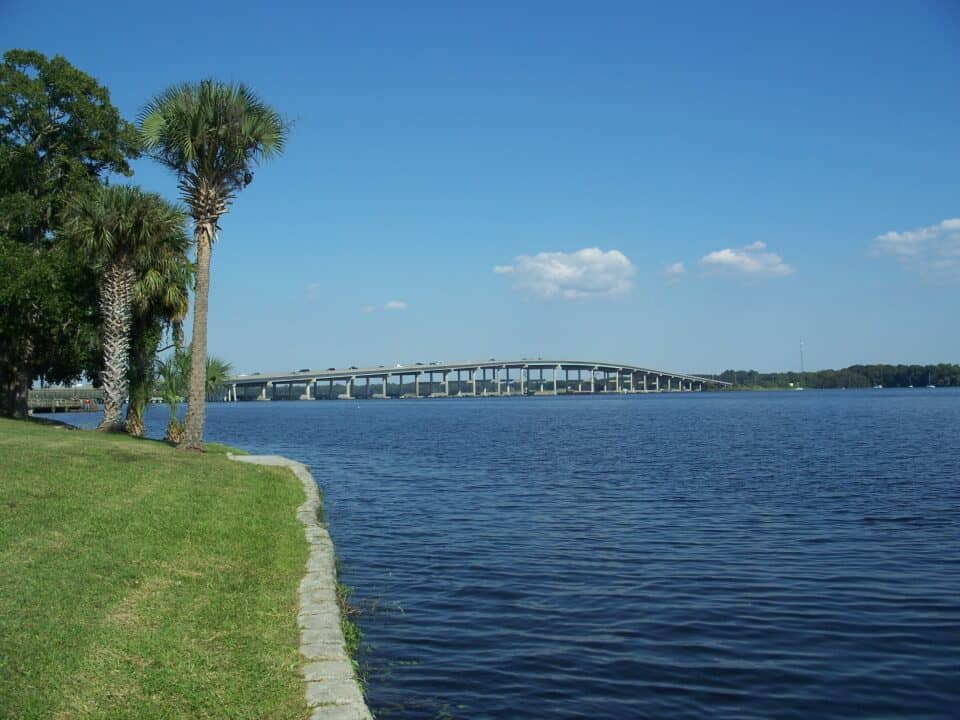
Welaka sits where the St. Johns River widens into Little Lake George, and after Hurricane Ian in 2022 the slow-draining river kept rising for days and put water into roughly 200 homes around town — so here, flood coverage is a first-order insurance question, not an afterthought. We’re an independent Florida agency that compares 20+ homeowners carriers on one quote request, then builds the rest around it: auto, umbrella, and flood — which is its own policy, or an endorsement with a few carriers, everywhere in Florida, Welaka included.
Free and no-obligation. Talk to a licensed Florida agent — independent, so we represent many carriers rather than one.
What actually damages homes in Welaka
Start with the unglamorous truth: the claims we handle most often for river towns like this one don’t come off the water at all — they start inside the house. A supply line lets go behind a washing machine, a water heater rusts through, a drain line under a 1980s slab fails quietly. Our standing advice in Welaka is to carry as much water-damage coverage as you can qualify for, because qualifying is the real issue: past water losses, the age of the home, and the type and age of its plumbing can shrink that coverage — or exclude it outright — with some carriers. Others reward prevention, discounting for automatic water shut-off valves and leak-detection sensors. Which carrier fits depends on the specific house, and that’s exactly the comparison an independent agent runs. Fire sits at the other end of the ledger — far less frequent, but the claims that test whether your rebuild limit was honest.
For everyday weather, think thunderstorms before hurricanes. Summer convective storms rolling across the river throw lightning, hail, and straight-line wind at roofs, fences, docks, and electronics year after year, and they account for a steady share of what gets claimed in Putnam County. Named storms matter here too — but Welaka’s hurricane story has mostly been written in water, not wind. Irma in 2017 pushed the St. Johns to record stages along this stretch, and Ian in 2022 flooded the town outright (more on that in the flood section below). On the wind side, a wind-mitigation inspection is the cheapest leverage most owners have: documented roof-to-wall connections, deck attachment, and opening protection can earn credits that meaningfully move the premium.
Putnam County sits on karst geology, so buyers sometimes ask about sinkholes. The honest calibration for Welaka: reported sinkhole claim activity in this county is modest — a statewide study of 2006–2010 claims found roughly two-thirds concentrated in Hernando, Pasco, and Hillsborough counties, far to the southwest. Here, the ground hazard that defines the town is the river, not the karst. Sinkhole coverage is a know-your-risk question rather than a rate question, and if a specific property worries you, a pre-purchase sinkhole inspection settles more than any policy discussion can. The FAQ below walks through how Florida’s two-tier sinkhole coverage actually works.
The housing stock shapes the quote as much as the weather does. Welaka’s median construction year lands in the mid-1980s, and carriers price building eras as cohorts — construction type plus that cohort’s claims record — not on a straight age line, which is why a solid 1950s block house can out-quote a fast-built 1980s frame one. Roughly three in ten homes in town are manufactured units, against a Putnam County share of about 44%, more than five times the statewide figure; a narrower set of carriers writes manufactured homes, and the unit’s age and tie-downs drive eligibility. From the riverfront streets in the town grid to Sportsman’s Harbor and out to Mount Royal Airpark — the gated fly-in community three miles south with its own 3,000-foot lighted runway and boat slips — we quote each property against the carriers that compete for its era and construction. Documented roof age matters within that era question on every 1980s-built and 1990s-built home: keep the permit or invoice, because carriers price what they can verify. County-wide context lives in our Putnam County best-carrier guide.
One more Welaka-specific note: on the acreage properties strung along CR 309 between the state forest and the hatchery tracts, a few chickens, goats, or a horse kept for personal use can sometimes be brought into scope through mini-farm endorsements that some carriers offer — it’s carrier-by-carrier, never automatic. Boarding, training, or breeding for income crosses into commercial territory, which we don’t write but can point you toward.
Auto insurance in Welaka
Welaka runs on CR 309 — a two-lane county road that follows the river north to meet US 17 at Satsuma and south through Fruitland to Georgetown. Putnam County does have public transit — The Ride Solution runs buses out of the Palatka Union Depot — but its fixed routes center on greater Palatka, with limited express service beyond it. Practically, that means nearly every working adult in Welaka drives, most households run more than one vehicle, and a lot of those vehicles are trucks with a bass boat or utility trailer behind them.
We recommend at least 100/300 in liability limits — the level leasing companies typically require — with higher limits where they fit your assets. Add uninsured/underinsured motorist coverage: on rural two-lanes, the driver who hits you may be carrying Florida’s minimums or nothing at all, and UM/UIM is designed to stand in for the coverage they don’t have. If you’re carrying decent limits already, an umbrella policy is the opportunity to add a full extra layer over both auto and home — more on that below. Teen drivers, boat trailers, and the tow vehicle itself all belong in the same conversation, because bundling home and auto with one of our 25+ carriers across personal lines is where the pricing usually gets interesting.
Flood insurance in Welaka — how much, not whether
In Welaka the flood question was answered by the river itself. Irma in 2017 pushed this stretch of the St. Johns to what were then record stages. Five years later, after Hurricane Ian, the river kept climbing for days after the sky had cleared — a rise of roughly 3.7 feet that broke the marks Matthew and Irma had left — and local reporting counted roughly 200 homes in the Welaka area with water in driveways, streets, and living rooms. Milton in 2024 then sent the gauge at Astor, just upstream, past its own Ian peak. Three named storms across the 2017–2024 seasons, each one a flood event more than a wind event here.
The reason is the river’s plumbing. The St. Johns falls only about 30 feet over its entire 310-mile run, so it drains slowly; the water that fell across central Florida during a storm keeps arriving at Little Lake George long after the sky clears, and the crest can come a week or more behind the landfall. That’s also why the question for every Welaka homeowner — riverfront or not — is how much flood coverage to carry, not whether to carry any. Flooding is decided at the scale of your own lot: the home’s immediate surroundings, its elevation relative to the properties beside it, its first-floor height, and how the soil sheds water. Homes well back from the riverbank flood in heavy rain; it can and does happen far from any bank or shore.
Two mechanics worth knowing. First, standard homeowners policies exclude flood — a few carriers offer optional flood endorsements, but they’re never automatic, so most owners buy a separate flood policy. Second, since FEMA’s Risk Rating 2.0, NFIP pricing runs on the property’s actual characteristics — distance to the flooding source, rebuild cost, elevation and first-floor height — not on the letter of a flood-map zone, and most existing NFIP policies can’t rise more than 18% per year under the 2014 Homeowner Flood Insurance Affordability Act. NFIP coverage caps at $250,000 for the dwelling and $100,000 for contents; for riverfront homes above those limits, private flood markets can quote higher. One more scheduling note if you’re with Citizens: Citizens ties flood insurance to wind coverage — a statewide requirement phased in through January 1, 2027.
Umbrella insurance in Welaka
An umbrella policy is designed to sit above the liability limits on your home and auto policies and add coverage in $1 million increments, subject to its own terms. River-town life carries more liability than it looks like it does: guests on your dock or boat, a pool behind a riverfront house, a teenager driving CR 309 at night, a trailer you’re towing through Palatka traffic. If a serious injury claim runs past your underlying auto or homeowners limits, the umbrella is the layer that’s designed to respond next — and for owners whose house is paid off or who are protecting retirement assets, that layer is often the cheapest seven-figure decision in the whole insurance file. Most umbrella carriers require higher underlying limits than a household starts with, commonly 250/500 bodily injury or a $300,000 or $500,000 combined single limit on the auto policy, $300,000 of liability on the home, and comparable limits on watercraft and motorcycle policies, which is why the umbrella and the limits conversation happen in the same review.
One Welaka quote request. 20+ Florida homeowners carriers.
We’re an independent Florida agency — a team serving all 67 counties — so one request here gets your Welaka home shopped across 20+ Florida homeowners carriers, including markets that write river-adjacent properties and the narrower set that writes manufactured homes. That breadth matters in a town where the housing runs from 1980s river cottages to fly-in homes at Mount Royal Airpark: no single carrier wants all of it, and the shared work is matching each house to the carriers that do.
Already insured? The fastest re-shop takes about a minute: connect your current policy through Canopy Connect — no documents to dig up — and we compare your coverage line-by-line against the market. Or just call or text 813.920.8181 and talk to a licensed Florida agent.