
Homeowners Insurance in High Springs, FL
The Santa Fe River is the reason a lot of people choose High Springs, and it’s the first thing we walk through on a quote: when Hurricane Debby stalled over North Florida in August 2024, the river kept climbing for days after the rain stopped, and flood is its own policy — or an endorsement with a few carriers — everywhere in Florida, High Springs included. Past that, your rate comes down to the home itself: its construction era, materials, documented roof age and rebuild limit. One quote request here puts 20+ Florida homeowners carriers to work, with straight answers about what’s realistic to place.
No obligation. Most quotes back same day. FL agency license L061107.
What shapes homeowners insurance rates in High Springs
Ask what actually generates claims in High Springs and the answer is quieter than the weather headlines: it’s water from inside the house. A supply line lets go behind the washer, a water heater rusts out in the garage, a slow drain-line leak works on a subfloor for months before anyone notices. That’s the loss pattern we handle most, and it’s why we encourage High Springs clients to carry as much water-damage coverage as they can qualify for. Qualify is the honest word — carriers look at prior water losses, the age of the home, and the type and age of its plumbing, and some will cap or even exclude water coverage based on what they find. A 1920s bungalow off Main Street and a new block home in Bailey Estates can get very different water-damage terms from the same carrier.
There’s a lever worth knowing here: several of our carriers discount for automatic water shut-off valves or leak-detection sensors, so the same device that prevents the loss can trim the premium. And because every carrier scores water risk differently, this is just the kind of thing shopping 20+ markets is for. Fire sits at the other end of the spectrum — the claim we see least often and the one that does the most damage when it happens, which is why we treat the rebuild limit as the most important number on the policy rather than a place to economize — and why carriers build replacement-cost estimators into every quote to gauge that rebuild number rather than guess at it.
Wind in High Springs is mostly a summer-afternoon story. North-central Florida’s convective thunderstorms deliver the routine wind, hail and lightning claims — a shingle line peeled back, a tree limb through the lanai screen, a surge-tripped AC board. Named storms are the second chapter, not the first, though Alachua County has real history: Hurricane Debby gusted to roughly 53 mph at Gainesville Regional Airport in August 2024, and Hurricane Helene pushed winds near 60 mph through the county the following month, downing trees and cutting power to tens of thousands. The county is landlocked, so storm surge isn’t part of the picture — but wind travels inland just fine, and so does water: creeks, low spots and the Santa Fe itself flood well away from any coast, High Springs included, which is why the flood section below gets its own conversation.
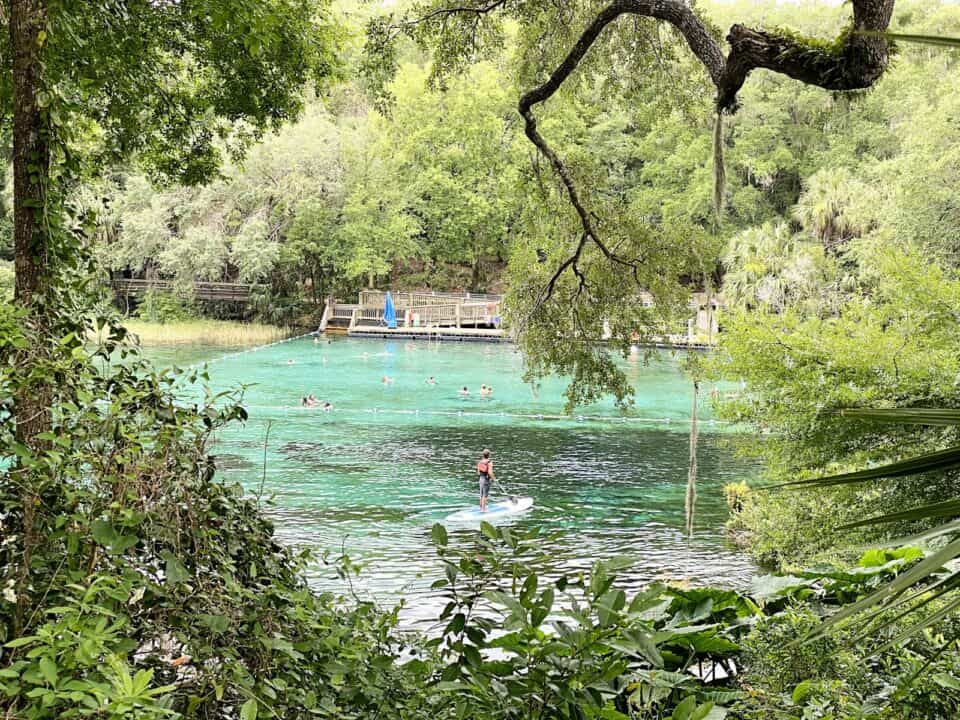
Now the subject everyone in spring country eventually asks about: sinkholes. High Springs sits on genuine karst — the same limestone plumbing that feeds Poe Springs, Ginnie Springs and Gilchrist Blue Springs, and that swallows the entire Santa Fe River underground at O’Leno State Park before it resurfaces at River Rise. Two facts keep that in perspective. First, every admitted Florida homeowners policy automatically includes catastrophic ground cover collapse coverage under s. 627.706, Florida Statutes — the sudden, severe collapse scenario is covered by law. Second, the state’s sinkhole claim activity has historically concentrated well south of here: roughly two-thirds of Florida’s 2006–2010 sinkhole claims came from Hernando, Pasco and Hillsborough counties.
Broader sinkhole loss coverage works differently. Carriers must offer it for an additional premium, but they don’t have to approve it — most require an inspection first, and in karst areas like this they frequently decline. Approved endorsements typically carry a deductible of 10% of your dwelling limit (not 10% of the claim), and Florida’s post-2011 law sets a strict five-part structural-damage test, so cosmetic slab or stucco cracking generally doesn’t qualify. One more thing worth knowing before you buy in High Springs: paid sinkhole claims are recorded with the county clerk and follow the property permanently, with seller disclosure required. Our advice is know-your-risk, not fear: if you’re purchasing here, a pre-purchase sinkhole inspection is money well spent, and we’ll tell you straight what is and isn’t realistic to place.
The housing stock itself does a lot of the pricing work. High Springs grew up as a railroad and phosphate town, and the blocks around its 1880s–1920s downtown still hold Queen Anne–era and early-1900s frame homes — character that carriers underwrite carefully, with four-point inspections and law-and-ordinance questions coming standard. Mid-century block homes ring the older core, and the growth edge belongs to newer subdivisions like Bailey Estates, built out from the late 2000s onward, and the Oak Ridge phases. Carriers price these eras as cohorts — construction type plus that generation’s claims record — which is why a solid 1950s block home can quote better than a hastily built 1980s frame one, and why documented roof age matters inside every cohort. A wind-mitigation inspection frequently pays for itself on the older stock. For the county-wide carrier picture, see our Alachua County best-carriers guide.
Finally, land. The city covers about 22 square miles for roughly 6,200 residents, so acreage properties with barns, workshops, wells and long fence lines are normal here. A few horses or backyard chickens kept for personal use can often stay in scope through the mini-farm endorsements some carriers offer — while boarding, training or breeding operations cross into commercial territory, and we’ll say so and point you to the right market rather than pretend a homeowners policy stretches that far.
Auto insurance in High Springs, FL
High Springs is a driving town by necessity. US 27 and US 41 meet right in town, US 441 carries commuters toward Alachua and Gainesville, and I-75 is a short run east — which means daily highway miles for most working households. Public transit barely reaches here: Gainesville’s RTS network is built around the city and the university, and what serves High Springs is a limited-day commuter connector, not a system you can build a schedule around. So every working adult drives, households run multiple vehicles, and the driveway census includes pickups, work trailers, teen drivers headed to Santa Fe High, and the canoe, kayak and dive trailers that come with living in spring country.
That mix shapes our advice. We recommend at least 100/300 in liability limits — the level leasing companies typically require — with higher limits where they fit your assets. Uninsured/underinsured motorist coverage belongs on the policy too: on rural two-lane roads and busy US highways alike, the driver who hits you may be carrying Florida’s bare minimum or nothing at all, and UM/UIM is designed to help close that gap for your own household. If you tow, remember that liability generally follows the tow vehicle while a trailer is hitched — worth a review if you haul boats or gear regularly.
Multi-vehicle households are also where bundling earns its keep. Placing home and auto through one independent agency opens same-agency discounts with several carriers and gives you one point of contact when something goes wrong. And once you’re carrying respectable liability limits on both policies, an umbrella becomes the natural next opportunity for added protection — more on that below.
Flood insurance in High Springs, FL
Here’s the ground truth about flooding in High Springs: it isn’t decided by a line on a map, it’s decided by your home’s immediate surroundings — its elevation relative to the lots next door, how the soil drains, and where the water in your neighborhood actually goes when a foot of rain falls. That’s true miles from the Santa Fe River, because karst terrain ponds in low spots and closed basins that never appear on a coastal-risk mental map. Flooding here can and does happen far from any riverbank.
The river adds its own signature. The Santa Fe runs along the town’s northern edge, and it floods slowly and stubbornly — fed by groundwater, it keeps rising after the sky clears. After Hurricane Irma in September 2017, the river rose roughly 15 feet in about 36 hours where it passes under I-75, cresting at levels FDOT called unprecedented. After Hurricane Debby in August 2024, the city staged sandbags for residents while forecasters projected a crest of roughly 44 feet at the gauge near High Springs, against a historic high of 48.5 — and homes in parts of High Springs, Alachua, Newberry and Gainesville took floodwater (our Gainesville flood insurance guide covers that end of the county). The National Weather Service maintains a river gauge near town precisely because this stretch matters.
So the question we work through with High Springs homeowners is never whether to carry flood coverage — everyone in Florida needs some — it’s how much. Standard homeowners policies exclude flood (a few carriers offer optional flood endorsements — never automatic), so the coverage comes from the NFIP, which tops out at $250,000 on the building and $100,000 on contents, or from private flood carriers that can go higher and are often competitive here. Alachua County has participated in the NFIP since 1984 and the Community Rating System since 1995, which can help local premiums. Note that lender rules and real risk are different questions: no mortgage requirement doesn’t mean no exposure.
On price, forget the old zone-letter thinking. Under FEMA’s Risk Rating 2.0, premiums ride on your specific home — distance to the flooding source, rebuild cost, elevation and first-floor height — and increases on most existing NFIP policies are capped at 18% per year under federal law. One more planning fact: Citizens ties flood insurance to wind coverage — a statewide requirement phased in through January 1, 2027. If you’re near the river corridor or in one of the low pockets in between, we’ll quote both NFIP and private markets and let the numbers argue.
Umbrella insurance in High Springs, FL
An umbrella policy stacks an extra layer of liability protection — usually starting at $1 million — above the limits on your home and auto policies. It’s designed to help when a serious claim blows past those underlying limits: a multi-vehicle accident on I-75 or US 441, a guest hurt around a pool or on acreage, a dog bite, a teen driver’s worst afternoon. High Springs life has plenty of these ordinary exposures — highway commutes, animals, trailers in tow, kids’ friends in and out — and a judgment doesn’t stop where your auto limit does; savings, home equity and future wages can all be reachable.
The economics tend to surprise people: because an umbrella sits behind your other policies, a meaningful amount of additional protection often starts around $500 a year for the first million. An umbrella comes with its own underlying-limit requirements, and every carrier is slightly different: most look for 250/500 bodily injury or a $300,000 or $500,000 combined single limit on the auto, $300,000 of liability on the home, and similar limits on boats and motorcycles, so we quote the layers together to make sure they connect. If you own property, drive daily and have anything to protect, an umbrella is usually the cheapest serious coverage decision on the table, and we can quote it alongside home and auto in the same pass.
One High Springs quote request. 20+ Florida homeowners carriers.
We’re an independent Florida agency — a team serving all 67 counties — which means we represent many carriers rather than one. One quote request puts 20+ Florida homeowners carriers, and 25+ across our personal lines, in competition for your business: home, auto, flood, umbrella, landlord, condo, renters and life. That breadth matters in a market that keeps moving. Alachua County’s own numbers tell the story: on May 31, 2024 the county had 3,556 Citizens policies representing about $1.09 billion in exposure; by May 31, 2026 that had fallen to 713 policies and roughly $114.7 million — an 80% drop as private carriers took risk back. When the market shifts like that, an agency that shops widely is the difference between riding a renewal and beating it.
Already insured? The fastest path is Canopy Connect — share your current coverage securely in about 30 seconds and we’ll re-compare it across our markets, including discounts many longtime policyholders never receive: water shut-off and leak-detection credits, military and first-responder programs, and same-agency bundle savings.