
Homeowners Insurance in Riverview, FL
Cornerstone Insurance is an independent Florida agency, and we compare 20+ Florida homeowners carriers for Riverview, FL and Hillsborough County homes. Most of Riverview was built after Florida’s 2002 building code took effect — which helps on wind pricing, though carriers rate your documented roof age, not your build year — and flood is its own policy — or endorsement — everywhere in Florida, Riverview included. This page covers what actually moves your rate — home, auto, flood, and umbrella.
Free, no obligation — talk to a licensed Florida agent today.
What shapes homeowners insurance rates in Riverview
The claim we see most isn’t storm damage — it’s water damage from inside the house. Supply lines, water heaters, washing-machine hoses, and A/C lines fail quietly and do expensive damage — and in subdivisions where thousands of homes went up in the same few years, those components tend to age out in the same few years too. It’s also a risk you can price down: many carriers offer real discounts for automatic water shut-off or leak-detection devices, and carriers differ widely in how they treat water damage — one of the bigger reasons the same home quotes very differently across the market. We encourage clients to carry as much water-damage coverage as they can qualify for — with the honest caveat that recent water losses, the age of the home, and the type and age of its plumbing can limit or even exclude water coverage with some carriers. Fire is the opposite profile — less frequent, but the most severe loss a home policy faces — which is why carriers embed replacement-cost estimators to gauge the rebuild-cost limit on every quote rather than guessing.
Riverview sits inland of Tampa Bay — and 2024 proved the water can still arrive by river. The routine claims here come from ordinary summer thunderstorms — straight-line wind, hail, and the lightning the Tampa Bay area is known for — and the big years add named storms. Hurricane Helene (September 2024) brought significant storm surge to Tampa Bay’s coastline, and Hurricane Milton (October 2024) produced record inland river flooding: the Alafia River near Lithia, just upstream of Riverview, crested at roughly its highest level since the 1933 hurricane. Wind is typically a covered peril on standard Florida homeowners forms — though some policies are written wind-excluded, so it’s worth confirming yours isn’t — and wind-mitigation credits (roof shape, deck attachment, clips and straps) are among the most reliable discounts on Riverview’s newer housing stock; if your home has never had a wind-mitigation inspection, that report alone can change your quote. Milton’s river flooding is the other half of the lesson: rising water is excluded on standard homeowners forms and needs its own policy — which is why the flood section below starts from how much, not whether.
Sinkholes in Hillsborough County are first a know-your-risk question — and only then a coverage question. Hillsborough is one of the three counties insurers call Sinkhole Alley: per the Florida Office of Insurance Regulation, roughly two-thirds of the sinkhole damage reported statewide between 2006 and 2010 came from Hillsborough, Pasco, and Hernando counties. That three-county corridor runs north from Hillsborough through Pasco and Hernando; southeast Hillsborough sits at its edge, on the same limestone karst, and the coverage rules are the same countywide. Every admitted homeowners policy in Florida automatically includes catastrophic ground cover collapse coverage — the severe, narrowly defined event. Full sinkhole loss coverage is a different story: Florida law requires carriers to offer it for an additional premium, but offering and approving are two different things — a carrier can require a property inspection first, carriers often decline the endorsement based on what the inspection finds, and in sinkhole-prone counties many homes can’t get it approved. When it is approved, it typically carries a 10% deductible calculated on your dwelling coverage limit — not on the size of the claim — plus the statute’s strict engineering definition of covered structural damage, which cosmetic cracking doesn’t meet. A paid sinkhole claim also leaves a permanent trail: the insurer must file the engineering report and the amount paid with the county clerk, where they’re recorded in the public records on the property — not a lien, but permanently searchable by future buyers and underwriters — and sellers have a legal duty to disclose it in any future sale. The practical move in a Sinkhole Alley county is a sinkhole inspection before you buy, so you know the ground before you price the policy — and we’ll tell you straight what is and isn’t realistic to place for your address.
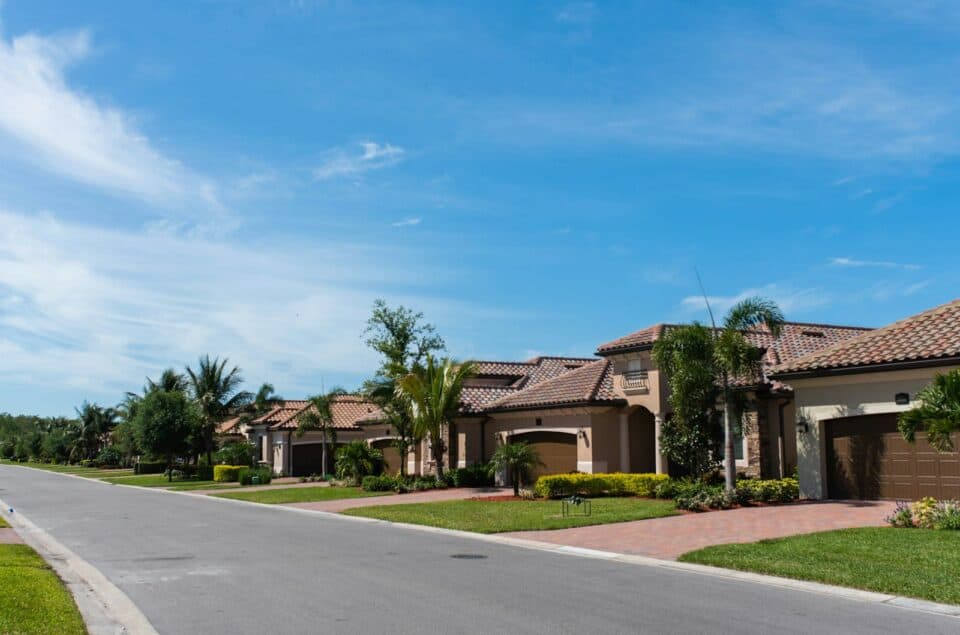
Riverview’s housing stock is young — which makes roof age the lever most owners are about to meet. Age isn’t a straight line, either: carriers price building eras — a concrete-block home from the 1950s can outperform a wood-frame home from a fast-built 1980s boom — because what’s really being priced is each era’s construction and its actual claims record. The Census counted 12,035 people here in 2000, 71,050 in 2010, and 107,396 in 2020 — one of the fastest-growing communities in the country over that stretch — so the overwhelming share of homes date from the early 2000s onward: Panther Trace, Rivercrest, and South Fork filled in largely through the 2000s and 2010s, while Triple Creek is still building out along the southern US-301 corridor. Carriers price the documented age of your roof, not the year the house was built — and a first shingle roof from the mid-2000s building wave is now at the age where underwriters start asking questions. A roof permit or inspection report proving a newer roof frequently opens carriers that would otherwise decline or surcharge the home; on 2000s-built homes here, that document is often the single biggest lever in the quote. We break down which carriers compete for Hillsborough County homes in our county carrier guide.
Auto insurance in Riverview, FL
Riverview’s traffic problem is well documented — FDOT is spending $81.7 million to rebuild the I-75 interchange at Big Bend Road because of it. That project widens Big Bend Road from four to six lanes, and a separate improvement project is reworking the US-301 intersection at Big Bend. Between I-75, US-301, Big Bend Road, Gibsonton Drive, and Bloomingdale Avenue, most Riverview households put in serious daily miles through construction zones and commuter congestion — everyday exposure here is higher than the suburban setting suggests.
That’s why our recommendation in Riverview is at least 100/300 liability — the floor most leasing companies set — with higher limits recommended as assets grow and an umbrella as the next layer, before adding uninsured/underinsured motorist (UM) coverage. Roughly 15 to 20 percent of Florida drivers carry no coverage, according to the Insurance Research Council, and when the other driver carries nothing, UM is designed to be the layer that responds for you and your passengers, subject to your policy’s terms. It is routinely the most underbought coverage we see on transferred-in policies.
There’s little practical transit out here, so Riverview households drive everything — two commuters leaving every morning, and plenty of families reaching the teen-driver years. Bundling home and auto with the same carrier group is one of the most reliable discounts in the Florida market, and as an independent agency we can quote the bundle across 25+ carriers in our personal lines rather than one company’s version of it.
Flood insurance in Riverview, FL
The Riverview flood question isn’t whether you need flood coverage — it’s how much. The river in Riverview’s name is the Alafia, Bullfrog Creek drains the community’s south side on its way to Tampa Bay, and low spots across these fast-built subdivisions pond in heavy summer rain. Hurricane Milton (October 2024) made the point locally: the Alafia crested at roughly its highest level since the 1933 hurricane, and the Hillsborough County Sheriff’s Office reported more than 700 high-water rescues countywide, many in the neighborhoods along the river. Hillsborough County has since committed $95 million in additional flood-protection work under its Rebuilding for Tomorrow program — including stream restoration in the Little Bullfrog Creek headwaters specifically to reduce downstream flooding in Riverview and Gibsonton. Check your own address with the county’s Find-My-Flood-Zone tool at hcfl.gov — then remember that Flooding is decided close to home — your immediate area, your elevation among adjacent properties, and the soil beneath you — which is why it can and does occur far from any coast. standard homeowners policies exclude flood (a few carriers offer optional flood endorsements — never automatic), so it’s a separate policy for every home.
“My lender doesn’t require it” means closing proceeded without it — the mortgage never evaluated how much flood coverage this home deserves. Zone X changes the mortgage paperwork; it doesn’t change where the Alafia goes in a Milton-sized rain. And here’s the part most Riverview homeowners haven’t heard: under FEMA’s Risk Rating 2.0 methodology, flood pricing is no longer driven by your zone. Premiums are built from your distance to a flooding source, your home’s rebuild cost, and its elevation and first-floor height — which means plenty of Riverview addresses price lower than people expect. Annual increases on most existing NFIP policies are capped at 18% under the 2014 Homeowner Flood Insurance Affordability Act. And one clear signal of where Florida is headed: Citizens policyholders with wind coverage must carry flood insurance under a phase-in scheduled to be complete on January 1, 2027 — inland addresses included.
We quote both NFIP policies (up to $250,000 building / $100,000 contents) and private flood markets, which can offer higher limits where the NFIP caps out — a real consideration in Riverview’s newer, larger homes. Five minutes with an agent settles the “how much” question for your specific address.
Umbrella insurance in Riverview, FL
An umbrella policy is designed to sit above your home and auto liability limits — typically sold in $1 million increments — and add an extra layer when a serious claim or lawsuit exceeds what those underlying policies carry. It’s the coverage people research after a close call on I-75; the better time is before.
The Riverview case for an umbrella is concrete. Households here stack liability exposures the way fast-growing family suburbs do: long daily commutes on I-75 and US-301 alongside drivers who often carry minimal or no insurance, backyard pools and community amenity centers, dogs, and teen drivers being added to policies every year. As home equity and savings grow, those are exactly the assets a serious liability claim targets — and an umbrella is designed to help protect them, subject to the policy’s terms and its required underlying limits.
Carriers require minimum liability limits on your home and auto policies before an umbrella attaches, so it’s usually quoted as part of a package review rather than alone — which is precisely the package review an independent agent runs in one pass across our carriers.
One Riverview quote request. 20+ Florida homeowners carriers.
Cornerstone is an independent agency — we represent many carriers rather than one. For Riverview homes we compare 20+ Florida homeowners carriers, and 25+ carriers across our personal lines for auto, flood, umbrella, and more. The market here is moving fast: Hillsborough County’s Citizens policy count fell roughly 74% in 2025 — the steepest drop in Tampa Bay — so if your policy was taken out of Citizens, a re-shop tells you whether your takeout carrier is actually the market’s best offer for your home. When the market moves, we re-shop; you keep one agency and one phone number: 813.920.8181.
Already insured? The fastest re-shop is sharing your current policies through Canopy Connect — about one minute, no documents to dig up — and we’ll come back with what the rest of the Florida market says about your house.