
Can You Buy Home Insurance During a Hurricane in Florida?
Once a storm has a name, nearly every carrier stops writing new policies, and we help you get covered before that window closes. Here is how binding moratoriums work and what you can still do during one.
In this guide
- The short answer: usually not once a storm is named or a watch is issued
- What a binding moratorium is and who declares it
- When moratoriums start and end (and why it varies by carrier)
- Can you buy home insurance during a hurricane in Florida if you’re closing on a house?
- Flood insurance has no moratorium — but it has a 30-day waiting period
- What you can still do while a moratorium is in effect
- Already insured? What a moratorium does and doesn’t change for you
- The takeaway: review and bind coverage before the season peaks
If you want to buy home insurance during a hurricane in Florida, the honest answer is usually no — once a storm has a name or the National Weather Service issues a tropical storm or hurricane watch or warning for any part of the state, nearly every carrier stops binding new coverage. There’s a storm forming in the Gulf and you’re wondering if you can still get a homeowners or flood policy bound right now? In almost every case, the window has already closed for new property coverage, though flood insurance through the NFIP works a little differently. Below we explain exactly how these “binding moratoriums” work, when they lift, and what you can still do.
The short answer: usually not once a storm is named or a watch is issued
Florida insurers temporarily stop writing new policies and stop adding or increasing coverage the moment a real storm threat appears. For most private carriers, the trigger is a named tropical system or a watch affecting Florida. For Citizens, the state-backed insurer, the rule is published in plain language: agents may not bind new applications or process changes that increase coverage when a tropical storm or hurricane watch or warning has been issued by the National Weather Service for any part of the state of Florida.
So if you’re staring at a cone of uncertainty on the news, the practical reality is that you most likely cannot get a brand-new homeowners policy bound until the threat passes. The fix is timing: bind coverage before a system has a name.
What a binding moratorium is and who declares it
A binding moratorium — also called a binding suspension or binding restriction — is a temporary pause during which an insurer will not issue new policies or increase coverage on existing ones. Each insurance company declares its own moratorium; there is no single statewide switch. Citizens publishes its restrictions openly on its binding alerts page, and private carriers notify their appointed agents directly.
The purpose is straightforward: it prevents someone from buying coverage only after the odds of a hurricane claim have spiked. That’s not unique to Florida, but our exposure means moratoriums here are frequent and often statewide. Because we’re an independent agency, we watch these alerts across the 20+ home carriers we represent so our clients aren’t caught off guard.
When moratoriums start and end (and why it varies by carrier)
Most carriers impose a moratorium as soon as the National Hurricane Center names a storm, or when a tropical storm or hurricane watch is issued for Florida. Citizens’ standard is the watch-or-warning trigger applied statewide — a watch anywhere in Florida can freeze new binding everywhere in the state.
When the moratorium lifts is less predictable. It is not standardized, and it varies from one insurer to the next. As a general industry pattern, restrictions are commonly lifted somewhere in the range of 24 to roughly 72 hours after the storm has passed or is no longer forecast to affect Florida — some carriers hold them longer. The takeaway: there is no guaranteed “it lifts at noon” moment, so don’t plan around it. If you need coverage, the only reliable approach is to have it in place before the season’s first threats appear. (Worth understanding alongside this is how your Florida hurricane deductible works once a hurricane claim is in play.)
Can you buy home insurance during a hurricane in Florida if you’re closing on a house?
This is where moratoriums hurt the most. Lenders require a bound homeowners policy at closing, and if carriers have suspended binding, you generally cannot get that policy issued — which means the closing can’t proceed. Florida insurers, as a rule, do not grant binding exemptions for loan closings, even though carriers in some other states sometimes do.
The lesson for buyers: lock your homeowners coverage in early. If you’re under contract during peak season, work with your agent to bind the policy well before the closing date, not the day of. For new construction closings, where timelines can shift, building in that buffer matters even more. Bind the policy when there’s clear weather, and a passing storm is far less likely to derail your closing.
Flood insurance has no moratorium — but it has a 30-day waiting period
Flood coverage works on a different clock. The National Flood Insurance Program (NFIP) does not impose storm moratoriums the way private property carriers do, but it has a standard 30-day waiting period before a new policy takes effect. So buying NFIP flood insurance as a storm approaches won’t help with that storm — the coverage simply won’t be active in time. The federal flood policy also excludes a flood that was already in progress in your community when the policy took effect, so a policy bought once flooding has begun may be excluded even after the 30 days pass; buy well before any storm has a name.
There are narrow exceptions to the 30-day wait: there is generally no waiting period when flood coverage is required in connection with making, increasing, extending, or renewing a loan, and a one-day wait can apply for properties newly mapped into a high-risk zone if purchased within 13 months of the map’s effective date. None of those exceptions exist to beat an oncoming storm. (As of now, the NFIP is authorized through September 30, 2026; reauthorization is handled by Congress.) If you’ve been assuming you’re safe because you’re in a low-risk area, read our explainer on Flood Zone X in Florida — the 30-day wait is exactly why waiting is risky. Most ranking pages miss this nuance: no flood moratorium, but the waiting period makes last-minute flood coverage useless for the storm at your door.
What you can still do while a moratorium is in effect
A binding freeze doesn’t leave you helpless. While restrictions are active, you can:
- Gather documents and get quotes ready so your agent can bind the instant the moratorium lifts.
- Pull together your wind-mitigation report, four-point inspection, and roof details so nothing slows the application later.
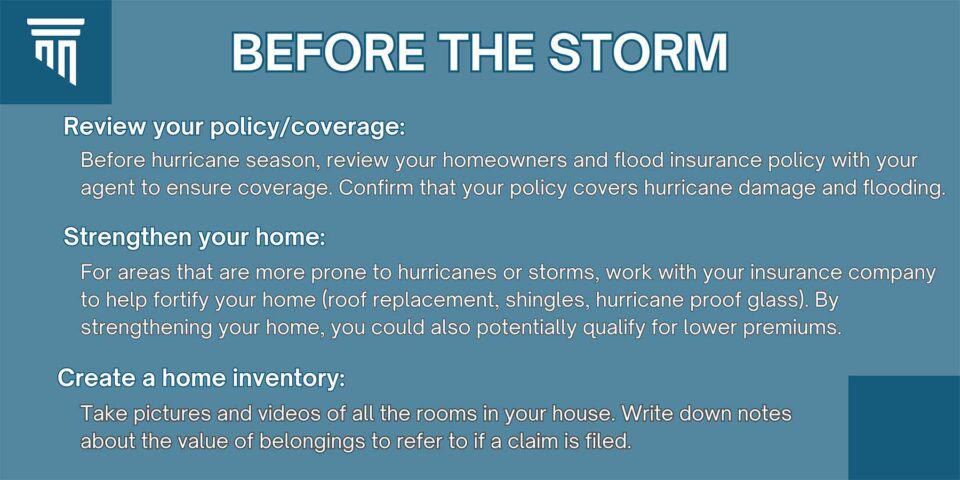
- Prepare and protect your home physically — shutters, documentation, and an inventory — since coverage changes are off the table.
- Confirm your existing policy details (we cover that next).
What you cannot do is start a brand-new homeowners policy or increase coverage limits during the freeze. That’s the whole point of the moratorium.
Already insured? What a moratorium does and doesn’t change for you
If you already have an active homeowners policy, a moratorium does not cancel it or reduce what you have — your existing coverage continues exactly as written, and a covered loss is still covered. What you generally cannot do during the freeze is increase coverage or add endorsements, because those count as coverage changes.
This is why a coverage review with your agent before peak season matters. Make sure your dwelling limit, deductibles, and any flood coverage reflect today’s rebuilding costs and risk — not what made sense three years ago. Our Florida homeowners insurance guide walks through what to check so you’re not trying to fix gaps after a watch is already posted.
The takeaway: review and bind coverage before the season peaks
You generally cannot buy home insurance during a hurricane in Florida once a storm is named or a watch or warning is issued — private carriers and Citizens alike suspend binding, and Florida insurers won’t make exceptions for closings. Flood insurance has no moratorium but a 30-day waiting period, so it can’t be rushed into place either. The only dependable strategy is to review and bind coverage during calm weather, well before the season peaks. Hurricane season runs June through November, and search interest spikes with every named storm — the people who scramble then are usually too late.
Talk to a Florida-licensed advisor
Cornerstone Insurance is an independent, Florida-licensed agency that compares 20+ A-rated carriers, so we can place coverage that fits your home and your budget — and tell you straight whether a moratorium is in effect. The smartest move is to get covered before a storm has a name. Get a quote today and let’s make sure your home is protected long before the next system forms in the Gulf.
Related Florida insurance guides
- Why your Florida home insurance went up, and how to compare for a stronger carrier
- Florida home insurance financial-strength ratings (AM Best, Demotech & Kroll)
- Bundle home, auto & umbrella in Florida with one local advisor
- Your homeowners insurance binder for closing in Florida
- Moving to Florida? How your home & auto insurance changes
Binding Moratoriums FAQ
There’s a storm forming in the Gulf u2014 can I still buy homeowners insurance in Florida right now?
Usually no. Once the National Hurricane Center names a storm, or the National Weather Service issues a tropical storm or hurricane watch or warning for any part of Florida, nearly all carriers u2014 including Citizens u2014 suspend binding of new policies and any coverage increases. You’ll generally have to wait until the threat passes and the carrier lifts its moratorium.
Can I buy flood insurance as a hurricane approaches?
You can purchase it, but it won’t help for that storm. NFIP flood policies have a standard 30-day waiting period before coverage takes effect. There’s no flood ‘moratorium,’ but the waiting period means last-minute flood coverage will not be active in time for an approaching hurricane. Limited exceptions (such as flood coverage tied to a new loan) exist but aren’t designed to beat a storm.
When does a binding moratorium lift after the storm passes?
It varies by carrier and isn’t standardized. As a general industry pattern, restrictions are often lifted within roughly 24 to 72 hours after the storm has passed or is no longer forecast to affect Florida, though some carriers hold them longer. Because there’s no guaranteed timing, the safest approach is to bind coverage before any storm threatens.
Will a binding moratorium stop my home closing?
It can. Lenders require bound homeowners coverage at closing, and Florida insurers generally won’t grant binding exemptions for loan closings during a moratorium. If carriers have suspended binding, the closing typically can’t proceed. The fix is to bind your homeowners policy well before the closing date, during clear weather.
Does a moratorium affect my existing homeowners policy?
No u2014 an active policy stays in force and a covered loss is still covered. A moratorium only blocks new policies and coverage increases. You generally can’t add endorsements or raise limits during the freeze, which is why reviewing your coverage before peak season is so important.
Who declares these binding moratoriums?
Each insurance company sets its own. There’s no single statewide switch. Citizens publishes its restrictions openly on its binding alerts page, and private carriers notify their appointed agents directly. As an independent agency, we monitor these alerts across the carriers we represent.