
Home Inventory for Insurance Claims: Build It Before the Storm
A home inventory is the simplest thing you can do today to get a claim paid fully later, and we help our clients build one before storm season. Here is what to record, how to store it, and what adjusters actually ask for.
Editor’s note: In September 2016, USA Today featured Cornerstone founder Joshua Butts in a piece on disaster preparedness and insurance — “Get busy before disaster strikes to maximize insurance payout.” The advice below is that thinking, updated for today’s Florida storm seasons.
What USA Today asked about disaster prep
The article’s premise was simple: the households that come through a disaster claim in the best shape are the ones that did their insurance homework before the storm had a name. Joshua contributed the agent’s-eye view — what actually separates a smooth claim from a painful one is usually documentation and policy knowledge that existed before the loss.
Nearly a decade of Florida storm seasons later, that’s still the whole game. Here’s what it looks like in practice.
Build a home inventory before you need it
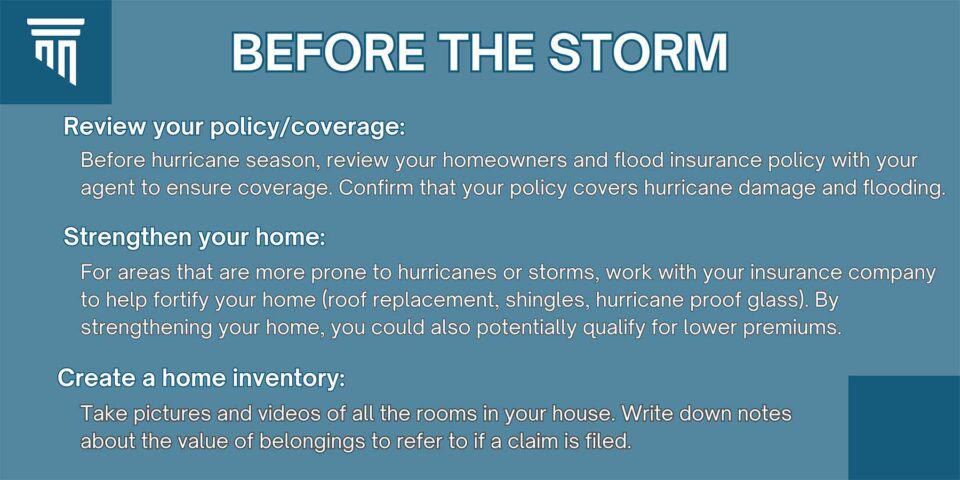
A home inventory is the single highest-value hour of disaster prep a homeowner can do:
- Walk the house with your phone. A narrated room-by-room video — open the closets, open the drawers, name what matters — captures more in ten minutes than a written list captures in a day.
- Document the big-ticket items. Receipts, serial numbers, and model numbers for electronics, appliances, tools, and jewelry. Photograph them individually.
- Photograph the house itself. Roof, exterior walls, fence, screen enclosure — dated photos of pre-storm condition answer questions later about what was damage and what was wear.
- Store it off-site. Cloud storage plus one copy somewhere outside the house. An inventory that rode out the storm on a flooded laptop helps no one.
- Refresh it. After renovations and big purchases, add to the video. Once a year is plenty.
An inventory doesn’t change what your policy covers — but when a claim happens, it substantiates what you owned and what condition it was in, which makes the adjuster’s job faster and the conversation cleaner.
Review your policy while the sky is clear
The second half of pre-season prep is knowing what your policy will actually ask of you. Working with your agent, before June, is the time to check:
- Your hurricane deductible, in dollars. Florida hurricane deductibles are percentages of your dwelling coverage — run the math so the number isn’t a surprise after a storm.
- Coverage A against today’s rebuild costs. Construction costs have moved a lot in recent years; a limit set years ago may not rebuild the same house.
- Wind mitigation credits. If your roof or openings have been upgraded since your last wind mitigation inspection, a new one can document features your premium isn’t crediting yet.
- Sub-limits and endorsements. Jewelry, collectibles, and equipment often carry special sub-limits — the pre-season review is where those gaps get caught, while there’s still time to address them.
If a storm hits: from inventory to claim
After a storm, the order of operations matters. Make sure everyone is safe. Photograph and video the damage before you touch anything. Make reasonable temporary repairs to prevent further damage — tarp the roof, board the window — and keep every receipt. Then file the claim directly with your carrier: their claims line and app are the fastest path to an adjuster, and your inventory, photos, and receipts go straight into that file.
Our role is the before: making sure that when you pick up your policy in June, you already know what’s in it, what it asks of you, and that the documentation exists. That’s the part USA Today was pointing at — the work you do before disaster strikes is the work that pays.
Common questions about home inventories
What should a home inventory include?
A narrated video walkthrough of every room, receipts and serial numbers for big-ticket items, dated photos of the home’s exterior and roof, and copies of your policy documents — all stored in the cloud plus one place outside the house.
Will an inventory raise my claim payout?
It doesn’t change your coverage — what’s paid depends on your policy’s limits and terms. What it does is substantiate what you owned and its condition, which speeds the claim and reduces back-and-forth with the adjuster.
Where should I keep my inventory and policy documents?
Cloud storage first, with access shared inside your household, plus one copy outside the home — a relative’s house or a safe-deposit box. Add your agent’s and carrier’s claim contacts to your phone before season.
Does my policy cover everything the inventory lists?
Not automatically — coverage depends on your policy’s limits, sub-limits, and endorsements, and categories like jewelry or collectibles often carry special caps. Reviewing the inventory against the policy with your agent before storm season is how those gaps get found.
Related Florida insurance guides
- Hurricane preparation for Florida homeowners
- The Florida hurricane deductible, explained
- Claim denied in Florida? What to do next
- The 2026 Florida homeowners insurance guide
This story FAQ
What should a home inventory include?
A narrated video walkthrough of every room, receipts and serial numbers for big-ticket items, dated photos of the home’s exterior and roof, and copies of your policy documents — stored in the cloud plus one place outside the house.
Will an inventory raise my claim payout?
It doesn’t change your coverage — what’s paid depends on your policy’s limits and terms. What it does is substantiate what you owned and its condition, which speeds the claim and reduces back-and-forth with the adjuster.
Where should I keep my inventory and policy documents?
Cloud storage first, with access shared inside your household, plus one copy outside the home. Add your agent’s and carrier’s claim contacts to your phone before storm season.
Does my policy cover everything the inventory lists?
Not automatically — coverage depends on your policy’s limits, sub-limits, and endorsements, and categories like jewelry or collectibles often carry special caps. Reviewing the inventory against the policy with your agent before storm season is how gaps get found.